
How much do real estate agents make depends entirely on which number you're looking at, and most of the numbers circulating online are the flattering ones, not the honest ones.
What's Inside

How much do real estate agents make is a question with wildly different answers depending on whether you're looking at the average, the median, or the number specific to someone in their first two years. This builds on the honest income framing in how to become a real estate agent with the full data behind it.
Quick honesty note
This is education, not a promise of income. Specific dollar figures below come from NAR and BLS data that updates annually; confirm current figures before relying on them for a specific decision.
The Short Answer
Income Isn't a Salary, It's a Scoreboard
Real estate agents are independent contractors paid entirely on commission, meaning there's no base salary, no guaranteed paycheck, and no employer withholding taxes on your behalf. Income tracks one thing directly: closed transactions. The same structure that gives top producers no ceiling on their earnings gives new agents no floor either, and understanding that asymmetry upfront changes how you should plan your first year financially.
The Mean-Versus-Median Gap

Real estate agent income is one of the most misunderstood statistics in the industry, largely because of the gap between the mean (average) and the median (the point where half earn more, half earn less). NAR's Member Profile data put the median gross income for Realtors at $58,100 in 2024, up from $55,800 the prior year, with net income after business expenses landing closer to $36,600.
BLS data puts the median for real estate sales agents somewhat lower, around $56,000 to $57,000 depending on the year. Meanwhile, some self-reported salary sites cite national averages well above $85,000, a figure inflated by a relatively small number of very high earners at the top of the distribution.
Swipe to see more →
| Segment | Reported income level |
|---|---|
| Median (all agents) | ~$58,100 gross |
| Top 20% | $200,000+ |
| Top 1% | $500,000-$2M+ |
The Number Most Course Sellers Don't Show You
$8,100. That's not a typo, and it's not before expenses.
NAR's Member Profile reports that agents with two years or less of experience had a median gross income of $8,100. Roughly 62% of new agents made under $10,000 in their first year, and once licensing fees, MLS dues, association fees, and marketing spend are factored in, more than half of new licensees actually lose money in their first year.
This is the gross commission line, the actual number on the median new agent's tax return, not a worst-case scenario. It's the single most important figure to internalize before committing financially to this career, and it's the one figure most licensing course marketing conveniently leaves out.
The first year is also the most expensive year: licensing fees, association dues, MLS access, and marketing costs all come out of pocket before a single commission check arrives. In competitive, high-priced markets, a motivated new agent with a genuine plan can still clear $50,000 to $60,000 or more, but that outcome is the exception in the first two years, not the typical case.
Income by Years of Experience

Swipe to see more →
| Years of experience | Median gross income |
|---|---|
| 0-2 years | ~$8,100 |
| 3-5 years | ~$30,000 |
| 6-15 years | ~$70,000 |
| 16+ years | ~$78,900-$92,500 |
For most agents, reaching what's generally considered full-time income, roughly $50,000 or more, takes 3 to 5 years of consistent, full-time work. Some new agents with a structured prospecting and lead-conversion system from day one have compressed this timeline meaningfully, but consistency, not raw talent, is the variable that separates them from agents on a slower track.
What Actually Drives the Variance
- Hours worked. NAR data shows members working 60 or more hours per week earn roughly three times more than those working under 20 hours, a genuinely direct relationship between time invested and income.
- Having a lead-generation system. Agents without a defined, repeatable way to generate new business consistently earn less and leave the industry at higher rates than those with one, covered in how to get real estate leads.
- Location and price point. Since commissions are a percentage of sale price, agents in higher-priced markets earn more per transaction even at identical commission rates.
- Specialization. Commercial agents commonly report higher median incomes than residential agents, and luxury specialists in high-value markets can earn well above typical residential figures.
- Team structure. A growing share of agents now work in formal teams rather than fully independently, which affects both income and how commission splits work in practice, covered in real estate agent commission.
One more practical detail worth planning around: as an independent contractor, you're responsible for the full 15.3% self-employment tax yourself, with no employer covering half of it the way a traditional W-2 job would.
Common Mistakes (and How to Dodge Them)
- Planning your first-year budget around the overall median or average. The realistic new-agent figure is dramatically lower; budget around the $8,100-and-under reality, not the $58,000 headline.
- Underestimating first-year expenses. Licensing, dues, MLS access, and marketing all come out of pocket before your first commission check, which is exactly why many new agents lose money in year one.
- Treating income as a function of talent rather than transaction volume. Consistency and a repeatable lead-generation system explain far more of the variance than raw skill.
- Working part-time while expecting full-time results. Hours invested correlates directly and substantially with income in this data.
- Forgetting self-employment tax when estimating take-home pay. As an independent contractor, you owe the full 15.3% yourself, not half of it.
Frequently Asked Questions
What is the median income for a real estate agent?
Around $58,100 gross annually according to NAR's most recent Member Profile data, though this figure hides enormous variance by experience level.
How much do first-year real estate agents actually make?
NAR data reports a median gross income of around $8,100 for agents with two years or less of experience, with roughly 62% earning under $10,000 in their first year.
Do new real estate agents lose money in their first year?
Many do. Once licensing fees, MLS dues, association fees, and marketing costs are factored in, more than half of new licensees have been reported to actually lose money in year one.
How long does it take to earn a full-time income as a real estate agent?
For most agents, reaching roughly $50,000 or more in income typically takes 3 to 5 years of consistent, full-time work.
What's the biggest factor separating high-earning agents from struggling ones?
Having a defined, repeatable lead-generation system is commonly cited as the decisive factor, more so than raw talent or market conditions.
Do real estate agents pay their own taxes?
Yes. As independent contractors, agents are responsible for the full 15.3% self-employment tax themselves, with no employer covering a portion of it.
Plan Around the Real Number, Not the Flattering One
How much do real estate agents make comes down to which stage of the distribution you're actually looking at. The median headline figure is real, but so is the far more sobering first-two-year reality most licensing course marketing skips over. Plan your entry into this career around the $8,100 number, not the $58,000 one, and let the experience-based progression, and a real lead-generation system, do the work of moving you up that curve.
Take This Further
Books by Nwaeze David to help you build real wealth through property.
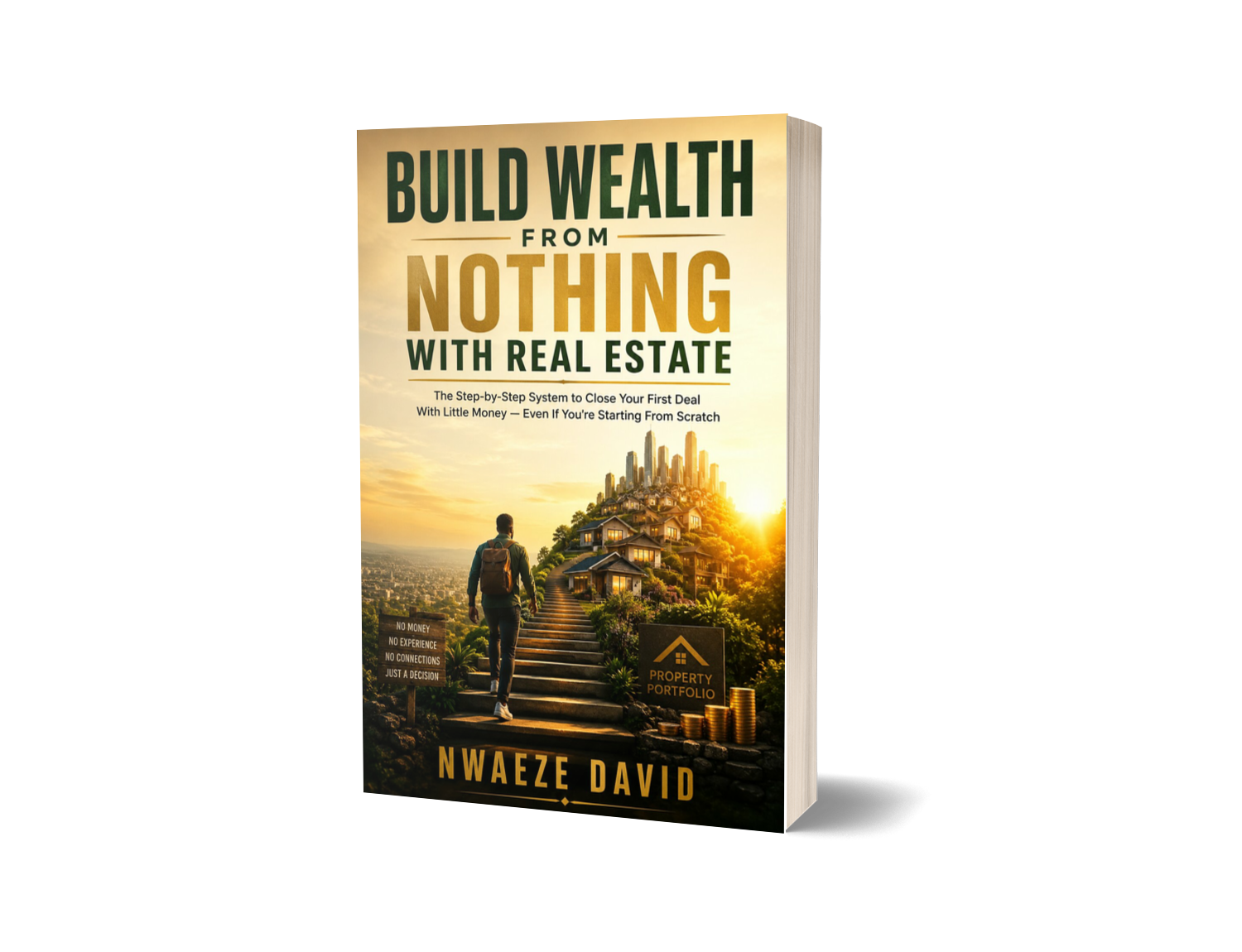
"You don't need a big deposit, perfect credit, or family money to build wealth in real estate. You need a system, the resourcefulness to work it, and the courage to start."
Get Your Copy →
"The AI Real Estate Investor gives you that system. It shows you exactly how to point AI at the parts of your business that actually make money."
Get Your Copy →
"The Diaspora Property Blueprint is the complete, step-by-step system for buying land and building wealth back home safely, from anywhere in the world."
Get Your Copy →Get help planning your first two years realistically
Join the newsletter for practical, no-hype breakdowns of building a real estate career, then step inside the private community where new agents talk honestly about what the first year actually costs and takes.
Keep learning: how to become a real estate agent · real estate agent commission · real estate agent vs broker.
Education only, not a promise of income. NAR and BLS figures update annually and are marked for verification where noted. Individual results vary substantially and depend on market, effort, and factors outside any single data source's control.

Written by
Nwaeze David
Nigerian digital entrepreneur, educator and author of three real estate books. He writes practical, honest guides for new investors, working realtors and Africans building back home from abroad.


