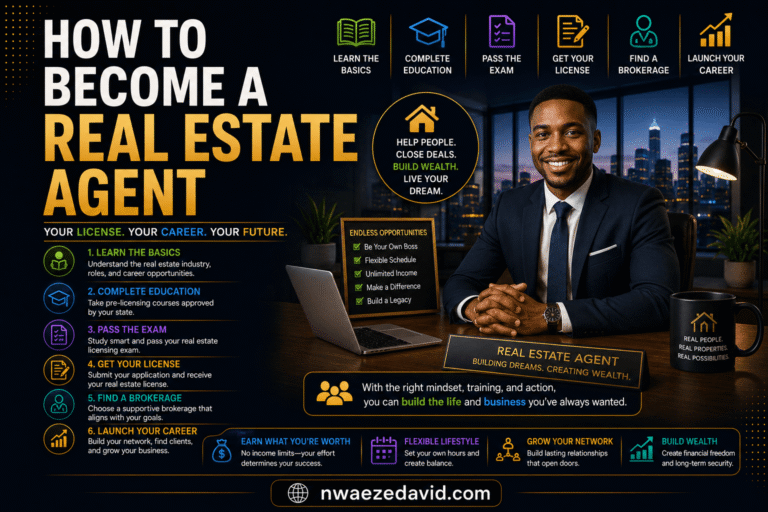
How to get your real estate license follows the same five steps in every state, but the actual hours, costs, and timeline can differ by a factor of three depending on where you live.
What's Inside

How to get your real estate license follows a consistent five-step path across all fifty states, but the specifics behind each step vary enough that "it depends on your state" is a genuinely useful answer, not a cop-out. This picks up where how to become a real estate agent left off, with the actual mechanics of getting licensed.
Quick honesty note
This is education, not legal or career advice. Hour requirements, fees, and exam details are set individually by each state and change periodically. Confirm current requirements directly with your state's real estate commission.
The Short Answer
The Five Steps Every State Shares

- Confirm your eligibility. Most states require you to be at least 18, and many require a high school diploma or GED, though a few states, including New York and North Carolina, don't require the diploma at all.
- Complete your state's pre-licensing education. Required hours range from roughly 40 to 180 depending on the state, covering general real estate principles, contracts, property law, and state-specific regulations.
- Pass the state licensing exam. Administered through Pearson VUE or PSI depending on your state, typically with separate national and state-specific portions.
- Clear a background check. Often including fingerprinting, this runs alongside or shortly after your exam.
- Activate your license under a sponsoring broker. In most states, a newly licensed agent cannot work independently and must be sponsored by a licensed broker to actually practice.
Why Pre-Licensing Hours Range From 60 to 180

Swipe to see more →
| State (examples) | Pre-licensing hours |
|---|---|
| Virginia, Maryland | 60 |
| Florida | 63 |
| North Carolina | 75 |
| New York | 77 |
| Nevada | 120 |
| California | 135 |
| Texas | 180 |
This isn't a minor detail, it's roughly a three-fold difference between the fastest and slowest states, and it directly determines how quickly you can realistically move from enrollment to your first sale. Confirm your state's exact number on its real estate commission website before choosing a course.
What It Actually Costs
- Pre-licensing education: $200-$700 online, or $200-$600 for in-person classroom courses.
- Exam fee: $50-$150, paid to Pearson VUE or PSI depending on your state.
- Background check and fingerprinting: $30-$100.
- Application and license fee: $50-$300, paid to your state licensing board.
Total costs commonly run $500 to $1,500 depending on your state and which course format you choose. A course like The CE Shop can be worth comparing directly against your state's specific hour requirement; best real estate schools & online license courses covers that comparison in full.
The Real Timeline
Most people complete the entire process in 2 to 6 months, though studying full-time can compress pre-licensing education and exam prep into as little as 4 to 8 weeks for someone with a lighter course load. Your weekly availability, not your state's specific hour count alone, is generally the single biggest factor in how long this actually takes you personally. Consistency matters more than intensity: students who stick to a regular study schedule tend to finish meaningfully faster than those who study in occasional bursts.
The Exam, and the Broker You Still Need
That pass rate is worth taking seriously rather than assuming a quick skim of your course materials will be enough; how to pass the real estate exam on your first try covers specific exam-prep strategy in depth. And passing the exam isn't actually the finish line: in most states you still need to find and be sponsored by a licensed broker before you can activate your license and start working, a decision that shapes your income, training, and support far more than most new agents expect going in. real estate agent vs broker covers that distinction and decision directly.
Common Mistakes (and How to Dodge Them)
- Assuming your state's requirements match a state you've heard about. Hour requirements alone vary three-fold; always confirm your specific state's numbers directly.
- Underestimating the exam. A 50-60% first-attempt pass rate means real preparation matters, not just completing your course hours.
- Waiting until after the exam to think about a sponsoring broker. This decision meaningfully affects your training and early income; research it in parallel with your coursework, not after.
- Choosing a course based on price alone. Pass-rate support and course quality can matter more than saving $100 upfront, especially if a weak course costs you a failed first attempt.
- Studying in occasional bursts rather than on a consistent schedule. Consistency is generally a bigger factor in your actual timeline than the total hours required.
Frequently Asked Questions
How many hours of pre-licensing education do I need for a real estate license?
It depends entirely on your state, ranging from roughly 60 hours in states like Virginia and Maryland to 180 hours in Texas.
How much does it cost to get a real estate license?
Total costs typically run $500 to $1,500, covering pre-licensing education, the exam fee, a background check, and your license application.
How long does it take to get a real estate license?
Most people finish in 2 to 6 months, though studying full-time can compress the process to as little as 4 to 8 weeks in states with fewer required hours.
What's the pass rate for the real estate licensing exam?
The national first-attempt pass rate is commonly cited around 50 to 60 percent, meaning real preparation matters beyond simply completing your coursework.
Can I work as a real estate agent immediately after passing the exam?
Generally no. In most states you also need to find and be sponsored by a licensed broker before you can activate your license and begin working.
Do I need a college degree to get a real estate license?
No. Most states require only a high school diploma or GED, and a few states don't require even that for a salesperson-level license.
Confirm Your State's Numbers, Then Commit to a Schedule
How to get your real estate license comes down to the same five steps everywhere, but the specific hours, costs, and timeline are genuinely state-specific enough to warrant checking directly before you enroll in a course. Once you know your state's actual numbers, consistency in your study schedule matters more than raw speed, and lining up a sponsoring broker in parallel with your coursework saves real time once you pass.
Take This Further
Books by Nwaeze David to help you build real wealth through property.
"You don't need a big deposit, perfect credit, or family money to build wealth in real estate. You need a system, the resourcefulness to work it, and the courage to start."
Get Your Copy →
"The AI Real Estate Investor gives you that system. It shows you exactly how to point AI at the parts of your business that actually make money."
Get Your Copy →
"The Diaspora Property Blueprint is the complete, step-by-step system for buying land and building wealth back home safely, from anywhere in the world."
Get Your Copy →Get help planning your path into the industry
Join the newsletter for practical, no-hype breakdowns of building a real estate career, then step inside the private community where new agents compare notes on courses, exams, and finding the right broker.
Keep learning: how to become a real estate agent · best real estate schools & online license courses · how to pass the real estate exam on your first try.
Education only, not legal or career advice. Hour requirements, fees, and exam details are set individually by each state and change periodically; figures here are illustrative and marked for verification where noted. Confirm current requirements directly with your state's real estate commission.

Written by
Nwaeze David
Nigerian digital entrepreneur, educator and author of three real estate books. He writes practical, honest guides for new investors, working realtors and Africans building back home from abroad.