Loading...

Commercial Real Estate Investing
Some links here are affiliate links. If you use them, I may earn a small commission at no extra cost to you. I only point to services I trust or have researched properly. Nothing here is financial advice.
Commercial real estate investing sounds like a game only the wealthy can play. It is not. This guide shows you what it really is, the ways ordinary people get in, and the numbers that separate a smart deal from an expensive lesson.
What's Inside

Commercial real estate investing means owning property that earns income from businesses rather than individual homeowners: offices, shops, warehouses, apartment buildings, and more. It carries a reputation for being complex and out of reach, but the truth is that some of the easiest, most passive ways to invest in property live in this space, and you can start with very little.
This guide covers the property types, the ways in from a single share to a whole building, the numbers that actually decide a deal, and the honest risks. Whether you want a hands-off REIT or your first commercial building, you will know where you stand by the end.
Quick honesty note
This is education, not financial advice. Commercial real estate carries real risk, including illiquidity and loss of capital, and rules, taxes, and market conditions vary by country and change over time. Figures here are illustrative. Do your own due diligence and speak to a licensed professional before investing.
What Counts as Commercial Real Estate
In short: Commercial real estate is property used to generate income from business tenants or from housing at scale. It includes office, retail, industrial, multifamily (apartment buildings of five or more units), hotels, and specialised assets like data centres and self-storage. You can invest directly by buying a building, or indirectly through REITs, crowdfunding, and funds.

| Sector | Examples | What to know |
|---|---|---|
| Office | Office buildings, business parks | Split market: prime space strong, older secondary space under pressure |
| Retail | Shopping centres, storefronts | Necessity and neighbourhood retail has held up well |
| Industrial | Warehouses, logistics, distribution | Strong demand from online shopping and supply chains |
| Multifamily | Apartment buildings (5+ units) | Treated as commercial; steady housing demand |
| Hospitality | Hotels, short-stay | Income depends on operations and travel demand |
| Specialised | Data centres, self-storage, medical | Fast-growing niches with specific expertise required |
How Commercial Differs From Residential
Commercial is not just a bigger house. The rules of the game change.
- Value comes from income. A commercial property is priced mostly on the income it produces, not on what the neighbours sold for. Raise the income and you raise the value.
- Leases are longer. Commercial tenants often sign multi-year leases, which brings more stable income, but a vacancy can hurt more and last longer.
- Tenants are businesses. Their success is tied to yours, so tenant quality and the lease terms matter enormously.
- Bigger numbers. Direct commercial deals usually need far more capital and stronger financing than a single-family rental, which is exactly why the indirect routes below exist.
New to property in general? Ground yourself first with real estate investing for beginners, then come back for the commercial layer in commercial real estate investing for beginners.
The Ways to Invest

| Way in | Money needed | Effort | What it is |
|---|---|---|---|
| REITs | Very low | Very low | Buy shares in a company that owns income property |
| REIT ETFs | Very low | Very low | A basket of REITs in one fund |
| Crowdfunding | Low | Very low | Pool money into specific deals online |
| Syndication | Medium to high | Low | A passive stake in a sponsor's larger deal |
| Private funds | High | Low | Pooled institutional-style investing |
| Direct ownership | High | High | Buy and run a commercial building yourself |
Most people should start indirect and passive. A REIT lets you own commercial property for the price of one share and get paid dividends, covered in what are REITs and how to invest in them. Crowdfunding platforms such as Fundrise let you back specific deals with a modest amount, more in real estate crowdfunding platforms compared.
Syndications give you a passive stake in a sponsor's deal, related to real estate syndication. And you can get broad exposure with no property at all, explained in how to invest in real estate without buying property.
Ready to own directly? Multifamily is the usual first step because it blends residential familiarity with commercial scale. See multifamily real estate investing guide.
The Numbers That Matter
Commercial deals live and die by a few figures. Learn these before you look at any property.
- Net operating income (NOI). Rental income minus operating expenses, before the mortgage. The engine of a commercial deal.
- Cap rate. NOI divided by price. It tells you the unleveraged yield and lets you compare properties. Commercial investors commonly look in the 4% to 10% range, with higher cap rates signalling more risk or a weaker location. Detail in cap rate explained.
- Cash-on-cash return. Annual cash flow divided by the cash you put in, your real return after financing.
- Internal rate of return (IRR). The total annualised return over the whole hold, including the eventual sale. How the pros compare deals.
- The pro forma. The projected income and expense model for a property. Learn to read one, and to question its assumptions, in how to read a commercial real estate pro forma.
In commercial real estate, you do not buy the building. You buy the income it produces and the reliability of the tenants who pay it. Underwrite the income, and the value takes care of itself.
The Lease Types You'll Meet
How a lease is structured decides who pays for what, and how predictable your income is.
- Gross lease. The tenant pays one rent and the owner covers most operating costs. Simpler, but your costs can eat your margin.
- Net leases. The tenant covers some costs on top of rent, shifting expenses to them.
- Triple net (NNN). The tenant pays rent plus property taxes, insurance, and maintenance. Very hands-off for the owner, popular with investors who want predictable, low-management income. See triple net (NNN) lease investing explained.
How to Get Started
- Start passive to learn the game. Put a small amount into a REIT or a crowdfunding deal, watch how it behaves, and read the reporting. Low risk, real education.
- Pick a sector and go deep. Industrial, multifamily, retail, and specialised assets each work differently. Choose one and learn it properly instead of dabbling in all.
- Build capital and relationships. Direct commercial needs money and a network of brokers, lenders, and operators. Passive investing while you build both is a smart bridge.
- Set up the right structure. Commercial is usually held in an entity for liability and tax reasons. Set one up cleanly with Doola when you are ready, and see how to form an LLC for real estate investing.
- Underwrite hard, then buy. Build your own numbers, stress-test the pro forma, and only move when the deal holds up under conservative assumptions.
What the 2026 market means for you
Commercial real estate is recovering after a tough stretch, with transaction activity rising and returns driven mainly by income rather than quick price gains. Industrial, multifamily, and necessity retail have held up, while older office space stays under pressure and prime office remains in demand. Careful sector and asset selection matters more than ever.
Risks to Respect
- Vacancy hits harder. One large tenant leaving can wipe out your income for months. Tenant quality and lease length matter.
- Tenant concentration. Relying on a single tenant means their trouble becomes your trouble.
- Illiquidity. Commercial property, and some crowdfunding and fund investments, can be hard to exit quickly. Do not invest money you may need soon.
- Financing and rate risk. Commercial loans reprice, and higher rates squeeze values. Understand your debt before you sign it.
- Sector shifts. The office story is a reminder that whole sectors can change. Buy into durable demand, not yesterday's winner.
Common Mistakes (and How to Dodge Them)
- Chasing a high cap rate blindly. A big number often signals big risk. Understand why the yield is high before you buy.
- Ignoring tenant and lease quality. The income is only as reliable as the tenants paying it and the lease that binds them.
- Underestimating expenses and CapEx. Commercial buildings have real ongoing costs. Budget conservatively.
- Over-borrowing. Too much debt turns a small dip into a wipeout. Keep a margin of safety.
- No reserves. Vacancies and repairs are certainties, not surprises. Hold cash for them.
- Jumping into direct deals too early. Learn passively first. The tuition is far cheaper.
Frequently Asked Questions
What is commercial real estate investing?
It means investing in property that earns income from business tenants or housing at scale, such as offices, retail, warehouses, apartment buildings, and hotels. You can invest directly by buying a building, or indirectly and passively through REITs, crowdfunding, syndications, and funds. Commercial property is valued mainly on the income it produces.
How much money do I need to start in commercial real estate?
Far less than you might think if you start indirectly. REITs and REIT ETFs can be bought for the price of a single share, and crowdfunding platforms let you invest a modest amount into specific deals. Buying a commercial building directly needs significant capital, financing, and a network, which is why most people begin passively and build up.
What is a good cap rate in commercial real estate?
There is no single right number. Commercial investors commonly look in the 4% to 10% range, depending on the sector, location, and risk. Lower cap rates usually mean safer, higher-demand assets with lower returns, while higher cap rates signal more risk or weaker locations. Always pair the cap rate with other measures like cash-on-cash return and IRR.
Is commercial real estate riskier than residential?
It can be. Vacancies are costlier and can last longer, income depends on business tenants, and deals are larger and less liquid. But it also offers longer leases, professional tenants, and strong income potential. Passive routes like REITs spread the risk across many properties, which makes them a lower-risk way to start.
What is a triple net (NNN) lease?
A triple net lease is one where the tenant pays rent plus property taxes, insurance, and maintenance. This makes it very hands-off for the owner and produces predictable income, which is why NNN properties are popular with investors who want steady, low-management returns, often with long leases to established tenants.
Can I invest in commercial real estate without buying a building?
Yes. REITs, REIT ETFs, crowdfunding, and syndications all let you invest in commercial property without owning or managing a building yourself. These give you exposure to the income and growth of large assets with far less capital and none of the day-to-day management, which is ideal for beginners and passive investors.
Start Small, Underwrite Hard, Grow Deliberately
Commercial real estate investing is not reserved for the wealthy or the expert. Start passively through a REIT or a crowdfunding deal, learn one sector deeply, respect the numbers and the risks, and build toward larger deals only when your knowledge and capital are ready. Buy the income, not the building, and let careful underwriting do the heavy lifting.
Take This Further
Books by Nwaeze David to help you build real wealth through property.
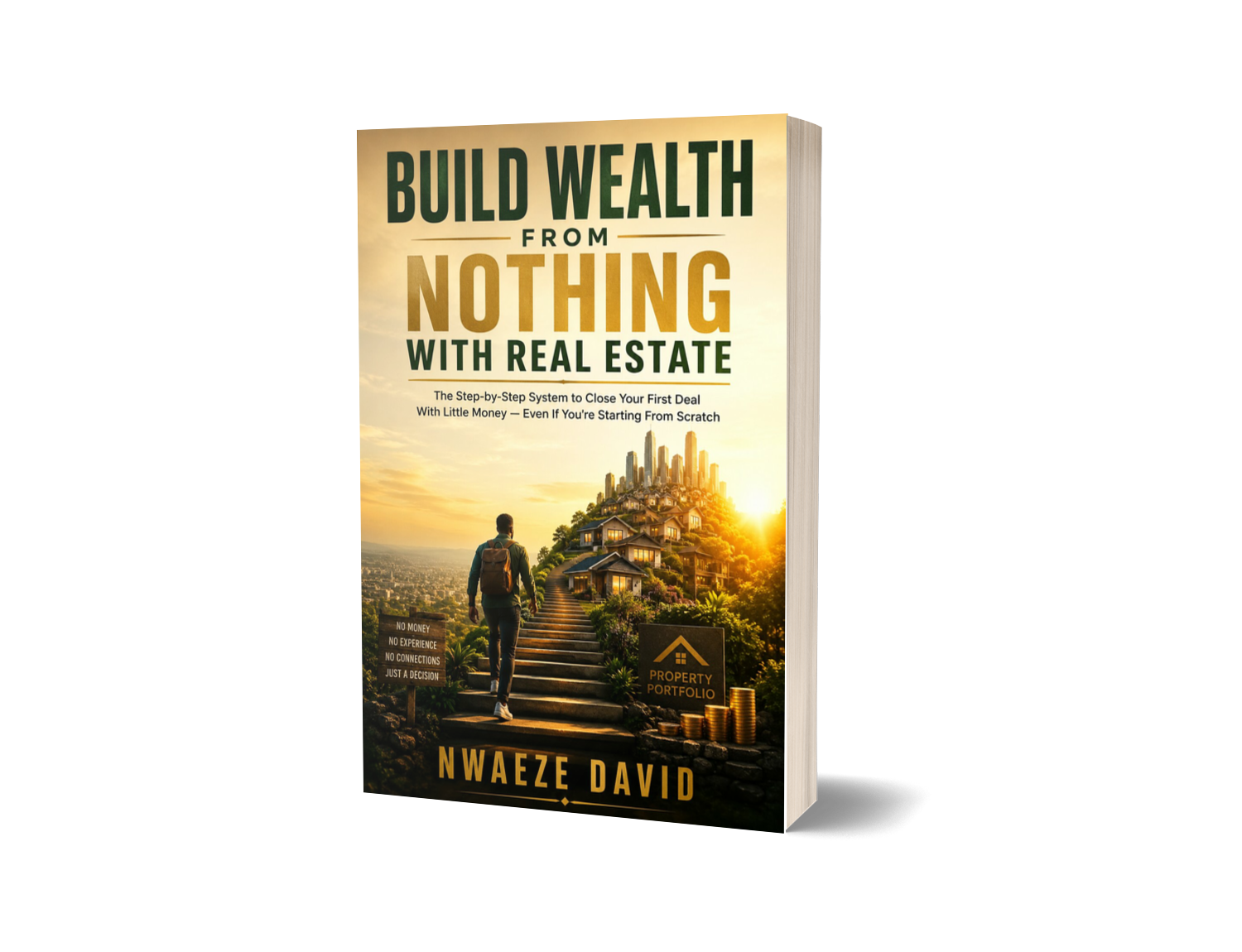
Beginner Wealth Building
Build Wealth From Nothing With Real Estate
"You don't need a big deposit, perfect credit, or family money to build wealth in real estate. You need a system, the resourcefulness to work it, and the courage to start."
Get Your Copy →
AI & Automation
The AI Real Estate Investor
"The AI Real Estate Investor gives you that system. It shows you exactly how to point AI at the parts of your business that actually make money."
Get Your Copy →
Diaspora & Africa
The Diaspora Property Blueprint
"The Diaspora Property Blueprint is the complete, step-by-step system for buying land and building wealth back home safely, from anywhere in the world."
Get Your Copy →Go deeper on the deals most investors never see
Join the newsletter for clear, practical lessons on investing and building wealth through property, then step inside the private community where we break down real deals, real numbers, and the strategy behind commercial success.
Keep learning: what are REITs and how to invest in them · real estate crowdfunding platforms compared · multifamily real estate investing guide · cap rate explained · triple net (NNN) lease investing explained.
Education only, not financial or legal advice. Commercial real estate carries risk, including illiquidity and loss of capital. Cap rate ranges, market conditions, and returns vary by sector, location, and time, and rules differ by country. Figures are illustrative. Do your own due diligence and consult a licensed professional before investing.
