Loading...

How To Finance Real Estate
Some links here are affiliate links. If you use them, I may earn a small commission at no extra cost to you. I only point to services I trust or have researched properly. Nothing here is financial advice.
Learning how to finance real estate is the skill that turns a good deal into a done deal. Master the loan types, the numbers lenders care about, and a few creative options, and you can buy property even without a pile of cash sitting in the bank.
What's Inside
- How real estate financing actually works
- Know your numbers first
- The main ways to finance real estate
- How much can you afford
- Getting pre-approved
- Financing an investment property
- Creative financing options
- Refinancing explained
- Financing from abroad
- Tools and lenders
- Common financing mistakes
- Frequently asked questions

Knowing how to finance real estate is what separates people who talk about buying property from people who actually own it. Most property is bought with borrowed money, and the person who understands the options pays less, qualifies for more, and closes deals others cannot.
You do not need to be rich. You need to know which loan fits your situation, what lenders are really checking, and how to line up the money before you shop. This guide covers all of it, from your first mortgage to investor loans and the creative routes when the bank says no.
Quick honesty note
This is education, not financial advice. Loan programs, rates, and rules differ by country and change constantly. Names like FHA and DSCR are common in the US and have equivalents elsewhere. Confirm what applies in your market, and talk to a licensed lender or broker before you commit.
How Real Estate Financing Actually Works
In short: Financing real estate means borrowing most of a property's price and putting down the rest, then repaying the loan over time. You control a valuable asset for a fraction of its cost. The trade is interest and the lender's rules, which is why choosing the right loan and terms matters as much as choosing the right property.
Every lender is really asking two questions. Can you repay this loan? And if you cannot, is the property worth enough to cover them? Everything they check, your credit, your income, your down payment, the appraisal, ladders back to those two questions. Once you see financing through that lens, the whole process stops feeling like a maze.

Know Your Numbers First
Before you look at a single listing, know the four numbers that decide your options and your rate.
- Credit score. The single biggest lever on your interest rate. A strong score can save you thousands a year on the same loan. If yours needs work, fix it before you apply. See how to buy a house with bad credit.
- Debt-to-income ratio (DTI). Your monthly debt payments divided by your monthly income. Lenders use it to judge whether you can handle another payment. Lower is better.
- Down payment. How much cash you put in. It sets your loan type, your rate, and whether you pay mortgage insurance.
- Reserves. Cash left after closing. Lenders want to see a cushion, and you should want one too.
Fix your credit before you shop, not after
Pull your credit early. Clear small balances, dispute errors, and avoid new debt in the months before you apply. A monitoring tool like credit-building tool helps you track and lift your score. A better score is often worth more than a bigger down payment.
The Main Ways to Finance Real Estate
Here are the loan types you will actually use, and when each one fits.
| Loan type | Typical down payment | Best for |
|---|---|---|
| Conventional (primary home) | 3% to 20% | Owner-occupiers with decent credit |
| Low-down / government-backed (e.g. FHA) | Around 3.5% | First-time buyers and house hackers |
| Conventional investment loan | 15% to 25% | Standard rental purchases |
| DSCR loan | 20% to 25% | Investors qualifying on rent, not income |
| Home equity / HELOC | Borrow against existing equity | Funding deals from a home you own |
| Hard money / bridge | 10% to 30%+ | Flips and fast, short-term deals |
| Seller financing | Negotiable | Buyers who cannot use a bank |

Conventional loans
The standard mortgage from banks and credit unions. Good credit gets the best rates. Down payments start low for a primary home and rise for investment property. Weigh it against a low-down option in conventional vs FHA loan.
Low-down owner-occupied loans
Government-backed loans like the FHA loan in the US let first-time buyers put down as little as 3.5%, and you can buy a small multi-unit place, live in one unit, and rent the rest. The cheapest way into property ownership for most people.
Investment property loans
Buying a pure rental usually needs 15% to 25% down and prices a little higher than a primary-home loan. Full detail in how to get a mortgage for an investment property.
DSCR loans
These qualify the loan on the property's rental income rather than your personal income, so self-employed investors and people past the usual loan limits can keep buying. Rates run a little higher than conventional. See DSCR loans explained.
Home equity and HELOCs
If you already own property, you can borrow against its equity to fund a deposit or a renovation. Powerful, but you are putting your existing home on the line, so use it carefully. See what is a HELOC and how to use it to invest.
Hard money and bridge loans
Short-term, higher-cost loans from private lenders, built for speed. Flippers use them to buy and renovate fast, then refinance or sell. Detail in hard money loans.
How Much Can You Afford
Affordability is not the biggest loan a lender will approve. It is the payment you can carry comfortably, with room for life. Lenders look at your DTI to cap the loan; you should look at your real budget to set it lower.
Add up the full monthly cost, not just principal and interest: taxes, insurance, any mortgage insurance, and upkeep. Then make sure it leaves room for savings and the unexpected. Run your own numbers in how much house can i afford? before a lender runs theirs.
Getting Pre-Approved
Pre-approval is a lender's written estimate of what you can borrow, based on a real check of your finances. It does two things: it tells you your true budget, and it tells sellers you are serious, which matters when offers compete.
- Gather your documents. Income proof, bank statements, tax records, and ID. Have them ready before you start.
- Check your credit. Know your score and fix quick issues first.
- Compare several lenders. Rates and fees vary a lot. Shopping a few can save you real money over the loan.
- Get the pre-approval letter. Then shop within that number, not above it.

Walk through it in detail in how to get pre-approved for a home loan, and compare providers in best mortgage lenders for first-time buyers.
Financing an Investment Property
Investor financing works differently from buying a home to live in. Expect a larger down payment, usually 15% to 25%, and a slightly higher rate. The upside is that the property's income can help you qualify, especially with DSCR loans that lean on rent instead of your paycheck. That is what lets investors scale past the point where salary-based lending stalls.
If you plan to hold rentals, pair this with rental property investing so your financing and your strategy line up.
Creative Financing Options
When the bank is not the answer, these are.
- Seller financing. The seller acts as the bank, and you pay them over time. Useful when you cannot get a traditional loan or want flexible terms. See seller financing.
- House hacking. Buy a small multi-unit place, live in one part, and let tenants cover the mortgage while you use a low-down owner-occupied loan.
- Partnerships. One person brings the money, another brings the deal or the work. Split the returns. Just put the terms in writing.
- HELOC or home equity. Turn the equity in a property you already own into the deposit for the next one.
Titling investor loans in an LLC
Many investors hold rentals inside an LLC to separate them from personal assets, and some investor loan programs allow closing directly in an LLC. If that is your plan, set the entity up properly from the start with Doola. More on the why in should you hold rental property in an LLC?.
Refinancing Explained
Refinancing replaces your current loan with a new one, usually to lower the rate, reduce the payment, or pull out equity as cash. It makes sense when the new terms save you more than the closing costs, over the time you plan to hold the property. It is also how the BRRRR strategy recycles capital: buy, fix, rent, then refinance to pull your money back out.
Learn when the math works in how to refinance your mortgage to lower payments.
The 2026 rate reality
As of early July 2026, the average 30-year fixed mortgage sits near 6.4%, a seven-week low, with investment-property loans priced higher and DSCR loans commonly in the 6% to 8% range. The lesson holds in any rate environment: buy when the deal works at today's rate, and refinance later if rates fall. Waiting for the perfect rate usually means competing with everyone else when it arrives.
Financing From Abroad
If you live overseas and want to buy back home, you have options. Banks in several countries offer diaspora mortgages built for citizens abroad, typically needing a diaspora or domiciliary account, proof of foreign income, and stronger documentation than a local loan.
Developer payment plans are a common alternative that spreads the cost across a build. See diaspora mortgage and the full playbook in diaspora real estate investment.
Tools and Lenders
A little help finding the right money goes a long way.
- Compare lenders and rates. A marketplace like mortgage rate marketplace lets you line up several quotes at once instead of calling banks one by one. Shortlist in best mortgage lenders for first-time buyers.
- Track and build credit. A tool like credit-building tool helps you raise the score that sets your rate.
- Set up your investing entity. If you are buying rentals in an LLC, Doola handles the formation cleanly.
Common Financing Mistakes (and How to Dodge Them)
- Shopping homes before financing. Get pre-approved first so you know your real number and can move fast.
- Ignoring your credit. A weak score quietly costs you thousands. Fix it before you apply.
- Not comparing lenders. Rates and fees vary widely. One extra week of shopping can save years of overpaying.
- Maxing out your approval. The biggest loan you can get is rarely the one you should take. Leave breathing room.
- Forgetting closing costs and points. The rate is not the whole cost. Read the full fee sheet.
- Choosing the wrong loan type. An investor loan for a home you will live in, or the reverse, costs you. Match the loan to the use.
- No reserves. Draining every dollar into the deposit leaves you exposed the first month something breaks.
Frequently Asked Questions
How much down payment do I need to buy real estate?
It depends on the loan. A primary home can need as little as 3% to 3.5% down with a low-down or government-backed loan. A conventional investment property usually needs 15% to 25%. Bigger down payments often unlock better rates and remove mortgage insurance. Always keep a cash reserve on top of the deposit.
What credit score do I need to finance a property?
Higher is cheaper. Many conventional loans want a mid-600s score or better, while the strongest pricing usually starts around 740 and up. Lower scores can still qualify through certain programs, often with a larger down payment or higher rate. Fixing your credit before applying is one of the highest-return moves you can make.
Can I finance real estate with no money down?
Sometimes, but rarely for free. Options include seller financing, partnerships where someone else brings the cash, using equity from a property you already own, or certain low-down owner-occupied loans. True no-money-down usually means trading cash for a higher rate, a stronger network, or more risk.
What is a DSCR loan?
A DSCR (debt-service coverage ratio) loan qualifies you on the property's rental income rather than your personal income. If the rent comfortably covers the loan payment, you can qualify without traditional income documents. It is popular with investors who are self-employed or scaling past conventional limits, and it usually needs 20% to 25% down.
Should I get pre-approved before house hunting?
Yes. Pre-approval tells you your real budget and shows sellers you are a serious buyer, which matters when offers compete. Get your documents and credit in order, compare a few lenders, and secure the letter before you start shopping so you can act quickly on the right property.
When does refinancing make sense?
When the new loan saves you more than the closing costs over the time you plan to hold the property, usually by lowering your rate or payment. Investors also refinance to pull out equity as cash, for example after renovating a property. Run the break-even math before you commit.
Line Up the Money, Then Go Get the Deal
Learning how to finance real estate is what makes everything else possible. Know your numbers, pick the loan that fits the job, get pre-approved before you shop, and keep a reserve for the surprises. Do that, and financing stops being the thing that blocks you and becomes the tool that grows you.
Take This Further
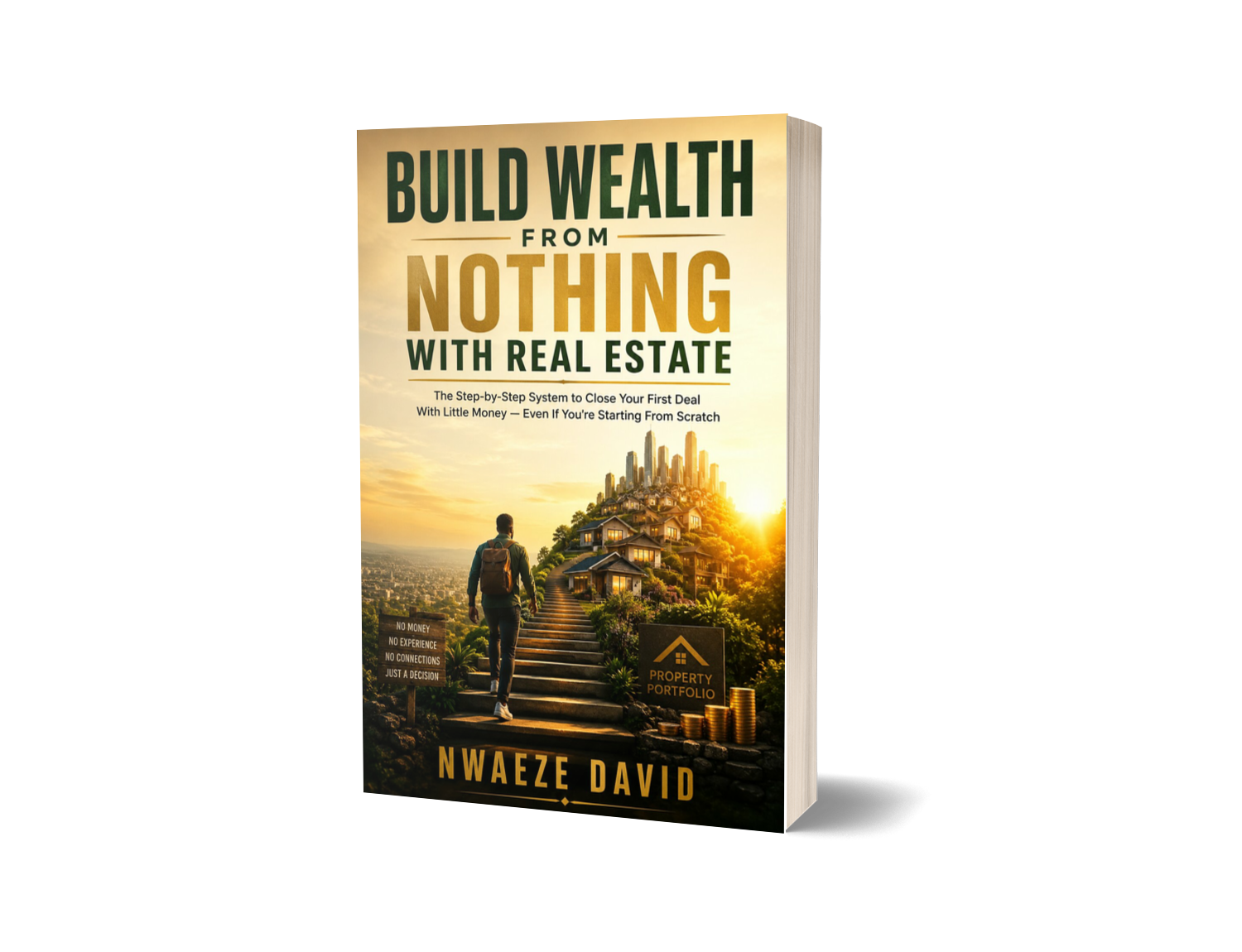
Books by Nwaeze David to help you build real wealth through property.
Beginner Wealth Building
Build Wealth From Nothing With Real Estate
"You don't need a big deposit, perfect credit, or family money to build wealth in real estate. You need a system, the resourcefulness to work it, and the courage to start."
Get Your Copy →
AI & Automation
The AI Real Estate Investor
"The AI Real Estate Investor gives you that system. It shows you exactly how to point AI at the parts of your business that actually make money."
Get Your Copy →
Diaspora & Africa
The Diaspora Property Blueprint
"The Diaspora Property Blueprint is the complete, step-by-step system for buying land and building wealth back home safely, from anywhere in the world."
Get Your Copy →Get the money moves most buyers never learn
Join the newsletter for clear, practical lessons on financing and building wealth through property, then go deeper inside the private community where we break down real deals, real loan structures, and the strategy behind smart borrowing.
Keep learning: how to get pre-approved for a home loan · conventional vs FHA loan · DSCR loans explained · how much house can i afford? · how to buy a house with bad credit.
Education only, not financial or legal advice. Borrowing carries risk, including the loss of your property if you cannot repay. Loan programs, rates, down payments, and rules vary by country and lender and change over time. Compare offers and speak to a licensed lender or broker before committing.