Loading...

Rental Property Investing
Some links here are affiliate links. If you use them to buy a tool, I may earn a small commission at no extra cost to you. I only point to tools I use or have researched properly.
Rental property investing is the steady, proven way most people build real wealth from real estate. Buy right, run the numbers honestly, and a good rental pays you every month while it grows in the background. This guide shows you how, start to finish.
What's Inside
- What rental property investing is
- Why rentals build wealth
- How much money you need
- The numbers that make or break a rental
- Long-term vs short-term rentals
- How to buy your first rental, step by step
- Financing a rental
- Finding and keeping good tenants
- Managing the property
- Tools that make it easier
- Common rental mistakes
- Frequently asked questions

Rental property investing is the closest thing real estate has to a wealth-building machine you can actually understand. You buy a property, rent it to good tenants, and it pays you while appreciation and loan paydown quietly build your equity. It is not glamorous. It is not fast. It has built more lasting wealth than almost anything else.
The catch is that rentals reward math and punish hope. A great rental and a money pit can look identical from the street. The difference is in the numbers, and by the end of this guide you will know exactly how to tell them apart.
Here is the full path: how much you need, how to analyze a deal, how to finance it, how to find tenants, and how to run it, whether you are down the road or an ocean away.
Quick honesty note
This is education, not financial or legal advice. The dollar figures here are illustrative and used to show how the math works. Prices, rents, rates, and tax rules differ by country and change over time. Confirm the numbers for your market, and speak to a licensed professional before you buy.
What Rental Property Investing Is
In short: Rental property investing means buying property to rent out for income. You collect monthly rent, pay the expenses and mortgage, and keep the difference as cash flow, while the property builds equity through appreciation and loan paydown. Do it well and one property funds the deposit on the next.
There are two broad flavours: long-term rentals, where a tenant signs a lease for a year or more, and short-term rentals, where you host guests for nights or weeks. Both can work. They just demand different budgets, effort, and stomachs for risk. We will compare them below.
Why Rentals Build Wealth
A rental does not pay you once. It pays you four ways at the same time.
- Cash flow. The rent left after every expense and the mortgage. Real money each month, and the reason to buy in the first place.
- Appreciation. Over long stretches, property values tend to rise. Because you bought with mostly borrowed money, even a modest rise is a large return on your own cash.
- Loan paydown. Your tenant's rent chips away at your mortgage every month. You get richer while someone else makes the payment.
- Tax benefits. In many countries you can deduct mortgage interest, running costs, and depreciation. In the US, for example, residential buildings are depreciated over 27.5 years, a paper loss that can shelter your cash flow from tax. Rules vary widely, so check yours with a tax pro.
Want the deeper foundation on how these forces compound? Start with real estate investing for beginners.
How Much Money You Need
Less than a full house price, but more than nothing. Your entry cost depends on the path.
A standard investment-property loan usually wants 20% to 25% down, plus closing costs and a cash reserve. On an illustrative $250,000 rental, that often means somewhere around $80,000 in total cash once you include the deposit, closing costs, and three to six months of reserves.
If that feels steep, house hacking lowers the bar dramatically: live in one unit of a small multi-unit place and an owner-occupied loan can need far less down. See how to become a landlord for the full starter path.
The reserve is not optional
Before you buy, set aside three to six months of that property's expenses. A boiler dies, a tenant leaves, a roof leaks. Investors who spend every dollar on the deposit turn the first surprise into a crisis. The cushion is what keeps a bad month from becoming a lost property.
The Numbers That Make or Break a Rental
This is the part that separates investors from gamblers. You do not need to be an accountant. You need to run these before you ever make an offer.

| Metric | What it tells you | Rough beginner target |
|---|---|---|
| Cash flow | Rent minus all expenses and the mortgage | Positive from day one |
| Cash-on-cash return | Annual cash flow divided by cash invested | 8% to 12% |
| Cap rate | Net operating income divided by price | Varies: prime 4-6%, average 6-8%, higher-risk 8-12% |
| The 1% rule | Monthly rent as a share of price | Near 1% (a screen, not a law) |
| The 50% rule | Expenses as a share of rent, before mortgage | Assume about 50% |
| Vacancy allowance | Buffer for empty months | 5% to 10% of rent |
Two numbers do most of the work. Cash-on-cash return tells you what your actual money is earning; below about 6% and a simple index fund may beat the hassle. Cap rate lets you compare properties in the same market before financing muddies the picture.
The mistake that sinks beginners is forgetting the quiet costs. Beyond the mortgage there are taxes, insurance, repairs, vacancy, management, and big-ticket items down the line, a roof, a heating system, a water heater.
Budget for those every month, not just when they hit. Run the full method in how to calculate rental property cash flow and pressure-test the shortcut in the 1% rule in real estate investing explained.
If your rent does not cover the mortgage, taxes, insurance, repairs, reserves, and management, you do not have a deal. You have a monthly bill with a tenant attached.
Long-Term vs Short-Term Rentals
Same asset, very different business.

Long-term rentals give you a tenant on a lease of a year or more. The income is steady, turnover is low, and the management is light. It is the calm, predictable heartbeat of a rental portfolio, and the best starting point for most beginners.
Short-term rentals, hosting guests through platforms like Airbnb, can earn two to three times the income of a long-term let in the right location. But they come with real trade-offs: heavier management, cleaning and furnishing costs, local regulations that can change fast, and higher vacancy risk in the off-season. It is a hospitality business, not passive income.
Neither is universally better. It depends on your market, your rules, and how hands-on you want to be. Dig into both in short-term vs long-term rentals, and if the nightly route appeals, see how to start an Airbnb business and Airbnb investment.
How to Buy Your First Rental, Step by Step
- Set the goal. Monthly cash flow, long-term appreciation, or a mix? Your answer decides the market, the property type, and the strategy.
- Get financing clarity first. Know what you can borrow before you shop, not after you fall in love with a listing. Get pre-approved so sellers take you seriously. See how to get pre-approved for a home loan.
- Pick a market that cash flows. In many high-cost cities, rents no longer cover costs. Investors are finding better rent-to-price maths in stable secondary markets. See best cities for rental property investment in 2026.
- Analyze deals until it is boring. Run the numbers above on many properties. Most will fail. That is the job. Never trust the seller's figures, build your own.
- Make the offer and inspect. When a property clears your numbers and your reserve is ready, offer. Always get the inspection. The thing you skip is the thing that costs you.
- Close and place a tenant. Complete the purchase, then screen carefully for a reliable tenant. The right tenant is worth more than a slightly higher rent from the wrong one.
- Manage, then repeat. Track every figure, keep good tenants, and let equity build. Then use it to fund the next one and grow toward a portfolio.

Financing a Rental
How you fund your rentals shapes how far you can scale.
- Conventional investment loans. The standard route, usually 20% to 25% down, priced a little higher than an owner-occupied loan.
- House hacking loans. Live in one unit of a small multi-unit property and qualify for low-down-payment owner-occupied financing. The cheapest way in for most beginners.
- DSCR loans. These qualify the loan on the property's rental income rather than your personal income, which helps investors keep buying past the point where salary-based lending stalls. See DSCR loans explained.
- The full money side. Every financing route in one place: how to finance real estate.
Finding and Keeping Good Tenants
Your tenant is your business partner for the length of the lease. A good one pays on time and treats the place well. A bad one drains your cash flow and your weekends.
Screen every applicant the same way: verify income, check references and rental history, and confirm they can comfortably afford the rent. Never skip screening to fill a vacancy faster, an empty month costs far less than a bad tenant who stops paying. The full method is in how to screen tenants the right way.
Managing the Property
You have two choices: manage it yourself or hire a property manager, who typically charges around 8% to 10% of the rent. Self-managing saves money and teaches you the business. A manager buys back your time and handles the 2 a.m. calls, which matters more as you add properties or buy further from home.
Buying in another city or another country is completely doable with the right setup and a manager on the ground. See how to manage rental property remotely and, for the diaspora buying back home, diaspora real estate investment. To weigh the cost, read how much does property management cost?.
The 2026 reality
With investment-property mortgage rates elevated, hovering in the high-6% range in 2026, appreciation-only bets rarely work for beginners. What is working is cash-flow-focused deals in stable markets where the property pays for itself at today's rate. The old saying fits: buy when the numbers work now, and refinance later if rates fall.
Tools That Make It Easier
A few good tools do the heavy lifting and pay for themselves.
- Analyze deals fast. A calculator like DealCheck runs cash flow, cap rate, and cash-on-cash in seconds so you can screen more properties in less time. See also best rental property analysis tools & calculators.
- Run the property. Landlord software like property management software handles rent collection, leases, and maintenance requests in one place. Compare options in best property management software for landlords.
- Screen tenants. A screening service like tenant screening tool pulls background and credit checks so you choose with data, not a gut feeling.
- Keep clean books. Rental income and expenses get messy fast, and clean records protect your deductions. QuickBooks is where most landlords land.
Common Rental Mistakes (and How to Dodge Them)
- Underestimating expenses. Counting only rent and mortgage, then getting buried by taxes, repairs, vacancy, and big-ticket items. Use the 50% rule as a floor.
- No reserves. The first repair becomes an emergency. Keep the cushion.
- Weak tenant screening. The most expensive mistake of all. A careful screen beats a fast fill every time.
- Buying negative cash flow on hope. Betting on appreciation to rescue a deal that loses money monthly. Make the numbers work at today's rate.
- Trusting the seller's numbers. Build your own analysis from real figures.
- Wrong market. A prestige address with thin yield will not pay you. Match the market to the goal.
- Over-borrowing. Stretching to the maximum loan leaves no room for a bad month. A safer deal you keep beats a bigger one you lose.
Frequently Asked Questions
How much money do I need to buy a rental property?
For a standard investment loan, plan on 20% to 25% down plus closing costs and a three to six month reserve. On an illustrative $250,000 rental that is often around $80,000 total. House hacking, where you live in one unit and rent the others, can lower the down payment sharply through owner-occupied financing. Figures vary by country and market, so confirm locally.
What is a good return on a rental property?
Many investors target a cash-on-cash return of 8% to 12%. Below about 6%, a simple index fund may deliver similar returns with far less work. Cap rates vary by property quality and market, roughly 4-6% for prime, 6-8% for average, and 8-12% for higher-risk properties. Always judge the return you actually keep after all expenses, not the gross rent.
Is rental property still worth it in 2026?
Yes, but the approach has tightened. With mortgage rates elevated, appreciation-only bets rarely work for beginners. Cash-flow-focused deals in stable markets, where the property pays for itself at today's rate, are what work now. Buy on numbers that hold today, and treat any future rate drop as a bonus, not the plan.
Should I choose a long-term or short-term rental?
Long-term rentals give steadier income, lower turnover, and lighter management, which suits most beginners. Short-term rentals can earn two to three times more in the right location but demand hands-on hosting, higher costs, and carry regulatory and off-season risk. The right choice depends on your market, local rules, and how active you want to be.
Can I invest in a rental property in another city or country?
Yes. Many investors own rentals far from where they live, using a local property manager for tenants, maintenance, and rent collection. The keys are strong screening, a trusted manager in place before you buy, and clear reporting. For buying back home from abroad, follow a strict title-verification process.
How do I calculate rental property cash flow?
Take the monthly rent and subtract every expense: mortgage, taxes, insurance, maintenance, vacancy allowance, management, and a reserve for big repairs. What remains is your cash flow. If it is positive after all of that, the property pays you. If it is negative, it costs you every month.
Build the Machine, One Rental at a Time
Rental property investing is not about luck or timing the market perfectly. It is about buying assets where the numbers work, screening tenants carefully, keeping reserves, and letting cash flow and equity compound over years. Start with one deal that pays you from day one. Then let it fund the next.
Take This Further
Books by Nwaeze David to help you build real wealth through property.
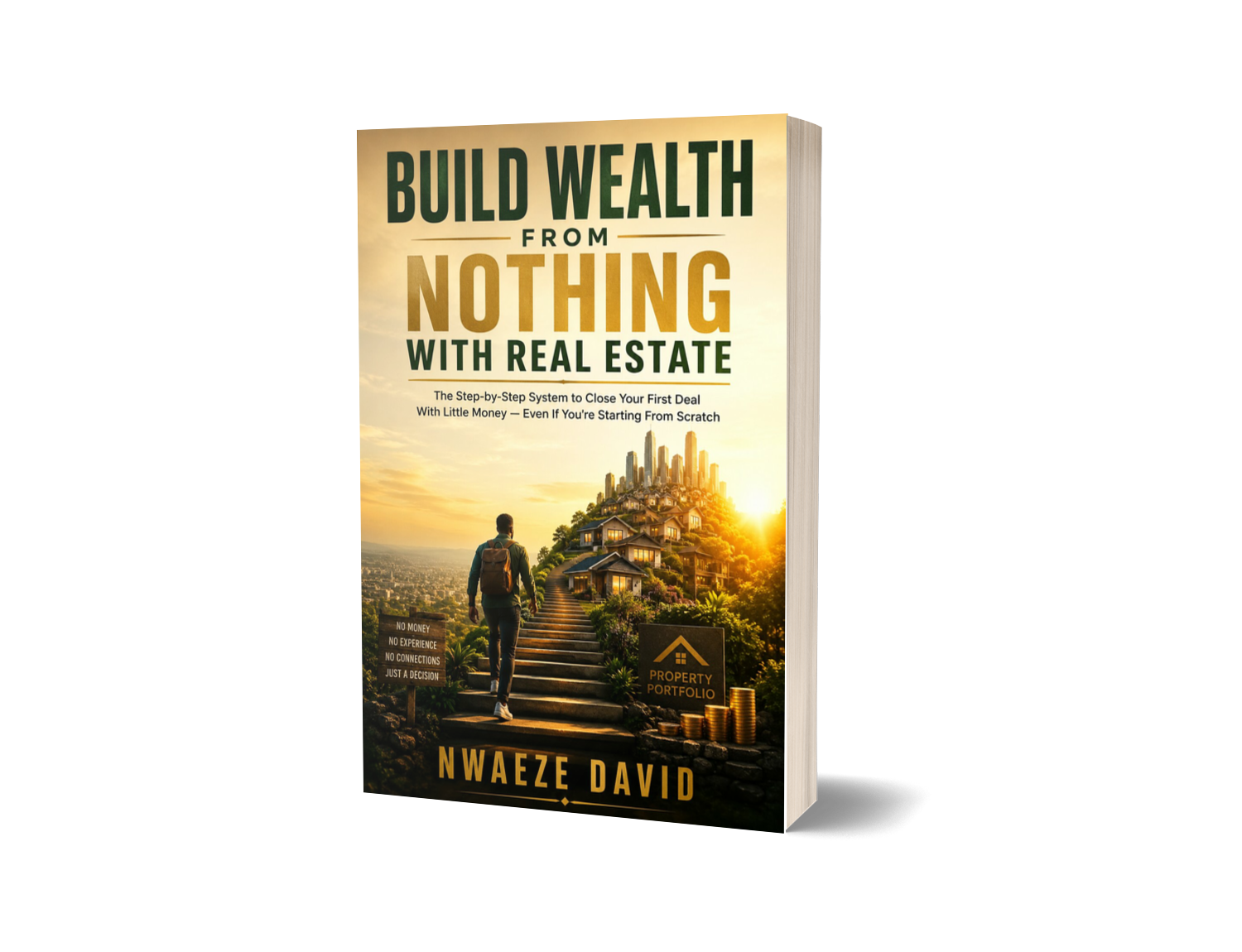
Beginner Wealth Building
Build Wealth From Nothing With Real Estate
"You don't need a big deposit, perfect credit, or family money to build wealth in real estate. You need a system, the resourcefulness to work it, and the courage to start."
Get Your Copy →
AI & Automation
The AI Real Estate Investor
"The AI Real Estate Investor gives you that system. It shows you exactly how to point AI at the parts of your business that actually make money."
Get Your Copy →
Diaspora & Africa
The Diaspora Property Blueprint
"The Diaspora Property Blueprint is the complete, step-by-step system for buying land and building wealth back home safely, from anywhere in the world."
Get Your Copy →Get the truths most landlords learn the hard way
Join the newsletter for practical, no-hype lessons on cash flow and building wealth through property, then go deeper inside the private community where we break down real deals, real numbers, and the strategy behind lasting rental income.
Keep learning: how to become a landlord · how to calculate rental property cash flow · how to screen tenants the right way · best cities for rental property investment in 2026 · how to manage rental property remotely.
Education only, not financial, tax, or legal advice. Property investing carries risk, including loss of capital and periods of negative cash flow. Dollar figures are illustrative. Rents, prices, rates, and tax rules vary by country and change over time. Speak to a licensed professional before making any investment decision.