Loading...

Real Estate Deal Strategies: The Complete Guide
Some links here are affiliate links. If you use them, I may earn a small commission at no extra cost to you. I only point to services I trust or have researched properly. Nothing here is legal advice.
Real estate deal strategies are how investors make money without waiting decades for appreciation to do the work. Wholesaling, flipping, and hunting off-market properties reward hustle and precise numbers over patience. Here is how each one actually works, and the rules that have gotten a lot stricter recently.
What's Inside

Most real estate advice is about buying and holding for years. Real estate deal strategies are the opposite mindset: find an undervalued or distressed property, add value or connect it to the right buyer, and get paid on the deal itself, sometimes in weeks, not years.
The three core strategies, wholesaling, fix and flip, and hunting off-market properties, share one requirement that separates the investors who profit from the ones who lose money: discipline on the numbers.
This guide covers how each strategy actually works, the math that protects your margin, and the legal landscape, which has shifted more in the past two years than in the previous ten.
Read this before your first deal
This is education, not legal or financial advice. Deal-based investing carries real risk, including loss of capital, and wholesaling in particular is regulated differently in nearly every state, with the rules changing frequently. Confirm the current law in your state and talk to a real estate attorney before you market your first contract.
What Deal Strategies Actually Means
In short: Real estate deal strategies are active investing methods where profit comes from finding and structuring a specific transaction, not from holding a property for years. The three main paths are wholesaling (assigning a contract for a fee), fix and flip (buying, renovating, and reselling), and sourcing off-market properties directly from motivated sellers before they ever reach the open market.
What all three have in common is that you make your money on the buy. Overpay, misjudge the repair costs, or misread the after-repair value, and no amount of hustle afterward saves the deal. That is why every strategy below is built around a formula, not a feeling.
Wholesaling Real Estate
Wholesaling means putting a property under contract, then assigning that contract to another buyer, usually a cash investor, for a fee. You never take ownership. It is the lowest-capital way into real estate investing, which is exactly why it draws so many beginners, and exactly why regulators have started paying closer attention.
The legal landscape has changed fast
Wholesaling remains legal in essentially every state, but 2025 and 2026 brought a wave of new rules. Connecticut, Ohio, Oklahoma, Maryland, North Dakota, and Tennessee all passed laws adding disclosure requirements, cooling-off periods, or registration rules for wholesalers, and states like Illinois, Texas, and California have tightened how many assignments you can do before you are treated as an unlicensed broker.
The safest practice everywhere: market only your contractual interest, never the property itself, disclose your role clearly and in writing, and use a real estate attorney for anything beyond a simple assignment.
The mechanics, once you are compliant, are straightforward:
- Find a motivated seller. Someone who needs to sell fast, an inherited property, a pending foreclosure, an out-of-state landlord tired of managing a property.
- Get the property under contract at a price that leaves room for your fee and the end buyer's profit.
- Find your cash buyer. Investors who want the deal without doing the sourcing work themselves.
- Assign the contract (or, in more regulated states, structure a double close) and collect your assignment fee, commonly a few thousand dollars up to tens of thousands on larger deals.
The full step-by-step guide, including how to structure your first contract, lives in wholesaling real estate.
Fix and Flip

Fix and flip means buying an undervalued or distressed property, renovating it, and reselling it for a profit, usually within months rather than years. It needs more capital and more risk tolerance than wholesaling, but it also lets you capture the full value you create, not just an assignment fee.
Every serious flipper starts with the same formula, known as the 70% rule:
The 70% rule
Maximum offer = (After Repair Value × 0.70) − estimated repair costs.
The 30% gap is not profit. It is a buffer that has to cover agent commissions, closing costs on both ends, holding costs (loan interest, taxes, insurance, utilities), and only then your actual profit. In slower or higher-risk markets, some flippers tighten to 60-65% of ARV for more safety margin. In hot, low-inventory markets, experienced flippers sometimes stretch to 75-80%, which leaves very little room for surprises.
Recent data puts average gross flip profit in the $56,000 to $78,000 range nationally, with typical ROI around 25% to 30%, though a meaningful share of flips break even or lose money, almost always because the buyer overpaid at acquisition or underestimated repairs.
Holding costs are the silent margin killer: every extra month you own the property adds thousands in interest, taxes, and insurance, so contractor delays and permit issues are not just an inconvenience, they are a direct hit to your profit.
You make your money when you buy. No amount of renovation magic or market appreciation rescues a flip you overpaid for at the start.
Full walkthrough of financing, renovation budgeting, and exit timing in fix and flip. Most flips are funded with short-term financing rather than a conventional mortgage, covered in hard money loans.
Finding Off-Market Deals

Both wholesaling and flipping depend on the same upstream skill: finding a deal before it hits the MLS, where you would be bidding against everyone else. A few methods dominate:
- Driving for dollars. Physically (or virtually, via Street View) touring neighborhoods to spot vacant or neglected properties, then tracking down the owner through public records or a skip-tracing tool. Cheap, scalable, and produces leads nobody else has.
- Direct mail. Targeted postcards or letters to lists of motivated sellers, absentee owners, tax-delinquent properties, pre-foreclosures, built from public records or a data platform.
- Skip tracing. Once you have an address, skip-tracing tools return the owner's phone number and email so you can actually reach them, often in one click through modern platforms.
- Networking. Agents, other investors, attorneys, and property managers regularly hear about a sale before it is public. Consistent relationships produce a steady trickle of first-look deals.
- Public records. Probate, tax delinquency, and code-violation filings all surface motivated sellers before a for-sale sign ever goes up.
The one pattern across every source: a single mailer or a single drive-by rarely closes a deal. Consistent follow-up (call, text, mail, repeat) is what actually converts a list into a contract. Full playbook in how to find off-market real estate deals.
Tools that shorten the search
A data platform that combines property records, owner contact info, and outreach in one place saves hours a week once you are running this consistently. A tool like Off-Market Deal Finding Platform handles list building and skip tracing together, so you spend your time on calls, not spreadsheets.
The Numbers That Decide Every Deal
Whichever strategy you run, the same three inputs decide whether a deal is good or a slow-motion loss.
- After Repair Value (ARV). What the property will sell for once fully renovated, based on recently sold comparable properties, not active listings and never the seller's hopeful asking price.
- Repair costs. Get a real, itemized contractor estimate. Guessing is how beginners lose their entire margin to a foundation issue or a permit delay nobody budgeted for.
- All-in costs. Purchase price, holding costs for however long the project realistically takes, and selling costs (commission, closing, concessions). Together with repairs, these are what the 30% buffer in the 70% rule is actually protecting.
Run these numbers before you fall in love with a property, not after. The deal either works on paper or it does not; charm and good intentions do not change the math.
Which Strategy Fits You
| Strategy | Capital needed | Effort | Speed to profit | Main risk |
|---|---|---|---|---|
| Wholesaling | Very low | High (sourcing + compliance) | Weeks | Legal/compliance, no buyer lined up |
| Fix and flip | Medium-high | High (project management) | Months | Overpaying, cost overruns, holding time |
| Off-market buy and hold | Medium-high | Medium | Years | Market and tenant risk |

Many active investors run more than one at once: wholesaling to generate quick cash while building capital, flipping to accelerate that capital, and quietly assembling a buy-and-hold portfolio with the properties that make more sense to keep. See the foundation for that longer path in real estate investing for beginners and rental property investing.
Learning From Books and Podcasts
Deal-based investing rewards pattern recognition, and the fastest way to build it without paying for your own expensive mistakes is studying people who have already made theirs.
A solid reading list and a rotation of investor podcasts will save you real money before you ever put a property under contract. See my picks in best books for real estate investors and best real estate podcasts to follow.
Common Mistakes in Deal-Based Investing
- Trusting the seller's ARV. Build your own comps from recently sold properties, never from an optimistic asking price.
- Guessing repair costs. Get a real contractor walk-through before you commit to a number.
- Ignoring your state's wholesaling rules. The compliance landscape has changed fast, and "everyone does it this way" is not a legal defense.
- No buyer lined up before contracting. Wholesalers who sign first and search for a buyer second sometimes default on the seller, which damages both their reputation and their capital.
- Underestimating holding time. Every extra month on a flip is a direct hit to your margin. Build delay into your projections, not just your hopes.
- One-and-done marketing. A single postcard or one drive-by rarely converts. The money is in the follow-up sequence.
- Skipping the professional team. A real estate attorney, a reliable contractor, and an experienced title company cost less than the mistake they prevent.
Frequently Asked Questions
Is wholesaling real estate legal?
Yes, in virtually every state, but the compliance requirements vary sharply and have tightened significantly in 2025 and 2026, with several states adding disclosure rules, cooling-off periods, or licensing thresholds for frequent wholesalers. The safe approach everywhere is to market only your contractual interest, never the property itself, and disclose your role clearly in writing. Confirm your specific state's current law with a real estate attorney before marketing your first contract.
What is the 70% rule in house flipping?
The 70% rule says your maximum offer should be no more than 70% of the property's After Repair Value minus estimated repair costs. The 30% gap covers commissions, closing costs, holding costs, and your profit, not just profit alone. It is a useful starting discipline, but many investors adjust it, tightening to 60-65% in slower markets or stretching to 75-80% in highly competitive ones.
How much money do you need to start wholesaling?
Very little compared to other real estate strategies, often just enough for an earnest money deposit (sometimes as low as $10 to a few hundred dollars), marketing costs, and any skip-tracing or data tools you use. You never purchase the property, which is why wholesaling is often called the lowest-capital entry point into real estate investing.
How profitable is house flipping in 2026?
Recent data puts average gross profit per flip in the $56,000 to $78,000 range nationally, with typical ROI around 25% to 30%, though a meaningful share of flips break even or lose money. Profitability depends heavily on buying at a real discount to After Repair Value, accurately budgeting repairs, and controlling how long you hold the property, since every extra month adds carrying costs that erode your margin.
What is the best way to find off-market real estate deals?
Driving for dollars, direct mail to targeted owner lists, and building relationships with agents, attorneys, and other investors are the most common methods. Whichever source you use, consistent follow-up across multiple contacts (not a single mailer or drive-by) is what actually converts a lead into a signed contract.
Should I wholesale, flip, or buy and hold?
It depends on your capital and how hands-on you want to be. Wholesaling needs the least capital but the most sourcing effort and legal care. Flipping needs more capital and project management skill but pays for the value you create. Buy and hold needs meaningful capital but builds wealth passively over years. Many investors combine strategies, using quicker deals to build capital for a longer-term portfolio.
Find the Deal, Then Trust the Numbers
Real estate deal strategies reward the investors who treat sourcing as a discipline and underwriting as non-negotiable. Wholesaling, flipping, and off-market sourcing all pay well when you run the numbers honestly and follow the current rules in your state.
Get those two things right, and deal-based investing becomes a repeatable business rather than a one-time lucky find.
Take This Further
Books by Nwaeze David to help you build real wealth through property.
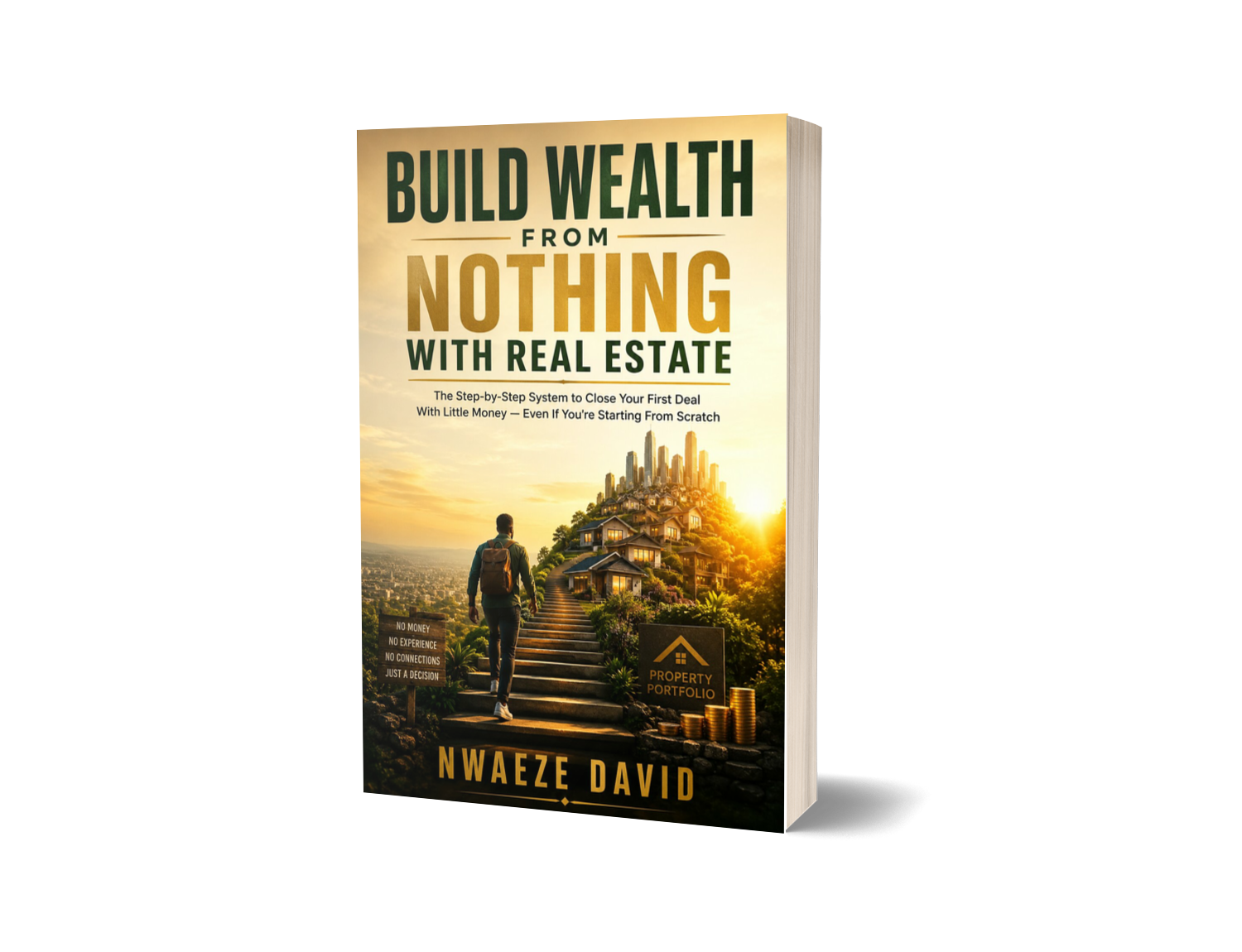
Beginner Wealth Building
Build Wealth From Nothing With Real Estate
"You don't need a big deposit, perfect credit, or family money to build wealth in real estate. You need a system, the resourcefulness to work it, and the courage to start."
Get Your Copy →
AI & Automation
The AI Real Estate Investor
"The AI Real Estate Investor gives you that system. It shows you exactly how to point AI at the parts of your business that actually make money."
Get Your Copy →
Diaspora & Africa
The Diaspora Property Blueprint
"The Diaspora Property Blueprint is the complete, step-by-step system for buying land and building wealth back home safely, from anywhere in the world."
Get Your Copy →Get the deal-finding systems most investors keep to themselves
Join the newsletter for practical, no-hype lessons on finding and structuring real deals, then step inside the private community where active investors share real numbers, real contracts, and the strategy behind consistent deal flow.
Keep learning: wholesaling real estate · fix and flip · how to find off-market real estate deals · best books for real estate investors · best real estate podcasts to follow.
Education only, not legal or financial advice. Deal-based real estate investing carries real risk, including loss of capital. Wholesaling laws and licensing thresholds vary sharply by state and change frequently; confirm current requirements with a real estate attorney before marketing any contract. Flip profit figures and ARV-rule percentages are national averages and illustrative, not guarantees, and vary by market and property.
