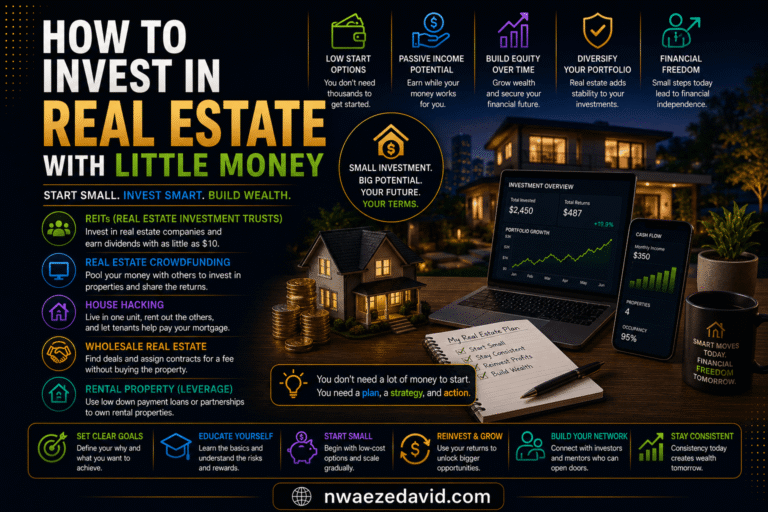
How much money do you need to invest in real estate? Most people only budget the down payment, then get blindsided by everything else. Here is the complete number, broken down by strategy and by price point, so nothing catches you off guard.
What's Inside

How much money do you need to invest in real estate depends entirely on which strategy you choose, ranging from $10 for a REIT share to well over $100,000 for a fully financed rental purchase. The number almost everyone gets wrong is not the down payment percentage, it is everything else that gets added on top of it.
This guide breaks the real total down by strategy and by price point, so you can save the actual number, not just the number that felt easiest to estimate.
Quick honesty note
This is education, not financial advice. Down payment rules, closing costs, and reserve requirements vary by lender, location, and loan program. Treat every dollar figure here as illustrative and confirm your specific numbers with a lender before budgeting around them.
The Short Answer
The Real Formula Everyone Underestimates

Almost everyone estimating their real estate budget stops at the down payment. The actual formula has three parts:
Total cash needed = Down payment + Closing costs + Reserves
Down payment is what you put toward the purchase price itself. Closing costs are the fees to complete the transaction, commonly 2% to 5% of the purchase price for buyers. Reserves are the cash cushion you keep, untouched, for repairs and vacancy after you own the property, commonly $5,000 to $10,000 per property or three to six months of expenses. Skip any one of these three and you are not actually ready to buy, even if you technically have enough for the down payment.
Minimum Capital by Strategy
Swipe to see more →
| Strategy | Typical minimum cash needed |
|---|---|
| REITs | $10-$500 |
| Real estate crowdfunding | $10-$5,000 |
| Wholesaling | ~$500-$2,000 (earnest money + marketing) |
| House hacking (owner-occupied, 2-4 units) | 3.5%-5% down + closing costs + reserves |
| Standard rental (investment loan) | 20%-25% down + closing costs + reserves |
| BRRRR | $50,000-$100,000+ (purchase + rehab + holding costs) |
| Fix and flip | Purchase + rehab + 6-12 months of holding costs as a buffer |
| Real estate syndication | $25,000-$100,000+ |
For the full breakdown of every strategy on this table, see 15 real estate investing strategies for 2026.
A Worked Example at Three Price Points

Here is what a standard investment property purchase (20% down, conventional financing) actually costs at three price points, all figures illustrative.
Swipe to see more →
| Purchase price | Down payment (20%) | Closing costs (~3%) | Reserves | Total cash needed |
|---|---|---|---|---|
| $150,000 | $30,000 | $4,500 | $5,000-$8,000 | ~$40,000-$43,000 |
| $300,000 | $60,000 | $9,000 | $7,000-$10,000 | ~$76,000-$79,000 |
| $500,000 | $100,000 | $15,000 | $8,000-$12,000 | ~$123,000-$127,000 |
Notice how much the reserve and closing cost lines add on top of the down payment alone, often 10% to 15% more cash than the down payment figure most people fixate on. Budgeting only the down payment on any of these leaves you dangerously thin the moment something goes wrong in year one.
The Hidden Costs People Forget
- Home inspection. A few hundred dollars, and never worth skipping to save it.
- Appraisal fee. Usually required by your lender, a few hundred dollars.
- Loan origination and underwriting fees. Often 0.5% to 1% of the loan amount, bundled into closing costs.
- Prepaid taxes and insurance. Lenders often collect several months upfront at closing.
- First-year maintenance and capital expenditures. Budget roughly 1% of the property's value annually, even in the first year.
- Vacancy between tenants. Assume at least one month of vacancy in your first year, even with careful screening.
How to Reduce How Much You Need
If the totals above feel out of reach, several legitimate paths lower the number without lowering your standards.
- House hack instead of buying a pure investment property. Owner-occupied financing drops your down payment from 20-25% to as low as 3.5-5%. See house hacking.
- Use gift funds or down payment assistance. Many first-time buyer programs allow gifted funds or offer grants toward the down payment.
- Start with a passive vehicle first. REITs and crowdfunding let you begin investing while you save toward a larger direct purchase. See how to start investing in real estate with little money.
- Partner with someone else's capital. Bring the deal or the management, let a partner bring the money, and split the returns.
- Consider seller financing. Negotiated directly with a seller, this can require far less upfront cash than a bank ever would. See seller financing.
Common Mistakes (and How to Dodge Them)
- Budgeting only the down payment. Closing costs and reserves routinely add 10-15% more cash than the down payment alone.
- Spending every dollar saved on the purchase. Zero reserves after closing turns the first repair into a crisis.
- Ignoring loan-specific costs like MIP or PMI. These add to your ongoing payment, not just your closing costs, and should factor into your total budget.
- Assuming the property price sets your strategy. A $500,000 property does not require $500,000 of skill. Many low-capital strategies exist regardless of local price points.
- Forgetting to price in vacancy. Assuming 100% occupancy from day one is the single most common rental budgeting error.
Frequently Asked Questions
What is the minimum amount of money to start investing in real estate?
As little as $10 through a REIT or a low-minimum crowdfunding platform. For direct property ownership, house hacking with owner-occupied financing can require as little as 3.5% to 5% down plus closing costs and reserves, while a standard investment property purchase typically needs 20% to 25% down on top of those same costs.
How much cash do I actually need to buy a rental property?
More than just the down payment. Add closing costs (commonly 2% to 5% of the purchase price) and reserves (commonly $5,000 to $10,000 per property, or three to six months of expenses) to your down payment for the real total. On a $300,000 property with 20% down, this can add up to roughly $75,000 to $80,000 total, not the $60,000 down payment alone.
Why do closing costs and reserves matter as much as the down payment?
Because skipping them leaves you exposed the moment anything goes wrong. Closing costs are required to complete the purchase itself, and reserves are what cover a vacancy, a repair, or a slow month without forcing you to sell or go into debt. Together they often add 10% to 15% more cash than the down payment figure most people focus on.
Can I invest in real estate with less than $10,000?
Yes, through REITs, crowdfunding platforms, or wholesaling, all of which can start well under $10,000. Direct ownership of a rental property with less than $10,000 total is difficult in most markets once you include closing costs and reserves, though house hacking in lower-cost markets can sometimes come close.
Does the property price determine how much money I need?
It affects direct ownership costs proportionally, a higher-priced property means a larger down payment, larger closing costs, and typically larger reserves. However, the property price does not determine your only option, since passive strategies like REITs and crowdfunding let you gain real estate exposure regardless of local property prices.
What is a reasonable reserve amount before buying a rental property?
A commonly cited guideline is $5,000 to $10,000 per property, or three to six months of the property's full expenses, held separately from your down payment funds. This reserve covers vacancy, repairs, and unexpected costs without forcing you to sell the property or take on high-interest debt during a rough month.
Save the Real Number, Not the Easy One
How much money you need to invest in real estate depends far more on your chosen strategy than on any single property's price tag. Whatever path you pick, budget the full formula, down payment, closing costs, and reserves, not just the number that was easiest to estimate. That discipline is what determines whether your first year in real estate builds confidence or drains your savings.
Take This Further
Books by Nwaeze David to help you build real wealth through property.
"You don't need a big deposit, perfect credit, or family money to build wealth in real estate. You need a system, the resourcefulness to work it, and the courage to start."
Get Your Copy →
"The AI Real Estate Investor gives you that system. It shows you exactly how to point AI at the parts of your business that actually make money."
Get Your Copy →
"The Diaspora Property Blueprint is the complete, step-by-step system for buying land and building wealth back home safely, from anywhere in the world."
Get Your Copy →Get the real numbers before you start saving
Join the newsletter for practical, no-hype breakdowns of what things actually cost in real estate, then step inside the private community where we help you budget your first deal properly.
Keep learning: how to start investing in real estate with little money · house hacking · 15 real estate investing strategies for 2026 · how to finance real estate · how to get pre-approved for a home loan.
Education only, not financial advice. Down payment percentages, closing costs, and reserve amounts vary by lender, location, loan program, and property, and change over time; figures here are illustrative and marked for verification where noted. Speak to a licensed lender before setting a savings target.

Written by
Nwaeze David
Nigerian digital entrepreneur, educator and author of three real estate books. He writes practical, honest guides for new investors, working realtors and Africans building back home from abroad.