Loading...

How to Invest in Real Estate With Little Money
Some links here are affiliate links. If you use them, I may earn a small commission at no extra cost to you. I only point to services I trust or have researched properly. Nothing here is financial advice.
You do not need a six-figure down payment to get started. Here are seven real ways to invest in real estate with little money, what each one actually costs, and the honest trade-offs of every path.
What's Inside
- Can you really invest with little money?
- Path 1: REITs and crowdfunding
- Path 2: House hacking
- Path 3: Low and no-down-payment loans
- Path 4: Seller financing
- Path 5: Lease options
- Path 6: Wholesaling
- Path 7: Partnering
- Comparing all seven paths
- What "little money" still requires
- Common mistakes
- Frequently asked questions

Learning how to invest in real estate with little money usually starts with a wall of doubt: surely you need a huge deposit, spotless credit, and family money to get in. You do not. Seven genuinely different paths let you start with anywhere from ten dollars to a few thousand, and this guide walks through exactly how each one works.
None of these are shortcuts to easy money. Each trades something, time, effort, risk, or control, for a lower cash requirement. Knowing that trade-off before you start is what separates a smart first move from an expensive lesson.
Quick honesty note
This is education, not financial advice. Dollar figures and platform minimums are illustrative and change, some are marked [VERIFY] to confirm before you rely on them. Every path here carries real risk, including loss of capital. Do your own research and talk to a licensed professional before investing.
Can You Really Invest With Little Money?
In short: Yes. You can start with as little as $10 through a real estate crowdfunding platform, or with a low down payment loan if you are willing to live in the property. The trade-off for low cash is almost always more effort, more risk, or less control over the deal, so match the path to what you actually have more of: money, time, or hustle.
Path 1: REITs and Real Estate Crowdfunding

The cheapest way onto this entire list. Crowdfunding platforms and real estate investment trusts (REITs) let you buy a small stake in a pool of properties, no mortgage, no tenants, no repairs. As of early 2026, minimums across popular platforms range from about $10 to $100 for non-accredited investors.
| Platform | Typical minimum | Structure |
|---|---|---|
| Fundrise | ~$10 | Diversified private eREIT funds |
| Lofty | ~$50 | Fractional individual properties |
| Arrived | ~$100 | Fractional single-family rentals |
| RealtyMogul | ~$5,000 | Non-traded REITs |
Be honest with yourself about the trade-offs. Your money is usually illiquid for years, some platforms have paused or restricted redemptions during rough stretches, and returns have varied wildly by fund and year, some very strong, some flat or negative.
This is a real way in, not a guaranteed one. A platform like Real Estate Crowdfunding Platform is worth researching properly, fees and all, before you commit a dollar. For the fuller picture on REITs specifically, see what are REITs and how to invest in them.
Path 2: House Hacking

Buy a small multi-unit property (or a house with extra rooms), live in one part, rent out the rest. Because you occupy the property, you qualify for owner-occupied financing with a far lower down payment than a pure investment loan requires.
Your tenants' rent then covers most or all of your mortgage. Of everything on this list, it is the path most beginners should look at first, because it combines the lowest realistic down payment with an asset you actually control. Full guide: house hacking.
Path 3: Low and No-Down-Payment Loans
House hacking works because of these loan programs, but you can also use them for a straightforward primary home that sets you up to convert to a rental later.
- FHA loans. As little as 3.5% down for qualifying owner-occupied buyers.
- VA loans. 0% down for eligible veterans and service members, one of the only true no-money-down mortgage options left.
- USDA loans. 0% down in eligible rural and some suburban areas, for buyers within income limits.
- Conventional low-down programs. Some lenders offer owner-occupied loans as low as 3% down for qualifying first-time buyers.
The catch: all of these require you to live in the property, at least initially, and most carry mortgage insurance until you build enough equity. Full breakdown of financing options in how to finance real estate.
Path 4: Seller Financing
Sometimes the seller becomes the bank. Instead of getting a mortgage from a lender, you make payments directly to the seller under agreed terms. This can work when a seller owns the property outright and wants steady income, or when you cannot qualify for traditional financing but can negotiate directly.
Down payment terms are whatever you and the seller agree to, sometimes far less than a bank would ever accept. Full mechanics in seller financing.
Path 5: Lease Options
A lease option lets you rent a property with the right, not the obligation, to buy it later at a price agreed upfront. Part of your rent can be credited toward the eventual purchase, letting you build a down payment over time while you live in or control the property.
It needs far less upfront cash than a purchase, though it requires a cooperative seller and a properly written contract to protect both sides.
Path 6: Wholesaling
You never buy the property at all. You put a property under contract at a price that leaves room for a profit, then assign that contract to a cash buyer for a fee.
Capital needed is minimal, sometimes just an earnest money deposit of a few hundred dollars, but it demands real hustle: finding motivated sellers, lining up buyers, and knowing your local compliance rules, since wholesaling regulations vary sharply by state and have tightened in several places recently. Full playbook in wholesaling real estate.
Path 7: Partnering
If you are short on capital but long on time, skills, or a great deal you found, bring in a partner who has the money and split the returns. This works when both sides bring something the other lacks: you find and manage the deal, they fund it.
The one non-negotiable is putting every term in writing before any money moves, who owns what, who decides what, and how you exit the partnership if plans change.
Comparing All Seven Paths
| Path | Money needed | Effort | Control |
|---|---|---|---|
| REITs / crowdfunding | $10-$100+ | Very low | None |
| House hacking | 3-3.5% down | Medium | Full |
| Low-down loans | 0-3.5% down | Medium | Full |
| Seller financing | Negotiable | Medium | Full |
| Lease option | Low option fee | Medium | Partial |
| Wholesaling | Very low | High | None (no ownership) |
| Partnering | Sweat equity | High | Shared |
Low money almost always means high effort somewhere else. Pick the trade you are actually willing to make, not the one that sounds easiest in a headline.
What "Little Money" Still Requires
Even the cheapest paths above are not free. You still need a real emergency reserve before you touch any of them, since the point of investing is to build stability, not to gamble your last dollar on a platform or a partnership.
You still need decent credit for most financing routes. And you still need to learn the numbers, cash flow, cap rate, and ARV, well enough to spot a bad deal before it spots you. "Little money" describes the entry cost, not the amount of homework required.
For the deeper foundation on how real estate actually builds wealth once you are in, start with real estate investing for beginners.
Common Mistakes (and How to Dodge Them)
- Treating crowdfunding as guaranteed passive income. Read the fee structure and redemption terms before you invest, not after you need your money back.
- House hacking with no reserve. A vacancy or repair with zero cash cushion turns your low-money entry into a real problem fast.
- Skipping the lawyer on seller financing or lease options. These agreements protect you only if they are written properly. A generic template is not enough.
- Wholesaling without knowing your state's rules. Compliance requirements vary a lot and have gotten stricter. Check before you market a contract.
- Partnering on a handshake. Get every term in writing before money changes hands, no exceptions.
- Chasing the lowest-money path instead of the right one. The cheapest entry is not always the smartest fit for your skills, time, and goals.
Frequently Asked Questions
What is the cheapest way to invest in real estate?
Real estate crowdfunding platforms are the cheapest entry point, with some accepting as little as $10 to $100 for non-accredited investors. It is also the most hands-off option, since you are buying a small stake in a pool of properties rather than owning or managing anything directly. The trade-off is illiquidity and variable returns, so research the platform's fees and terms carefully first.
Can I really buy a house with no money down?
In limited cases, yes. VA loans offer 0% down for eligible veterans and service members, and USDA loans offer 0% down in eligible rural and some suburban areas for buyers within income limits. Most other paths, including FHA loans at around 3.5% down, still require some cash, though far less than a conventional 20% down payment on an investment property.
Is house hacking a good way to start with little money?
Yes, it is often the strongest first move for beginners. Buying a small multi-unit property and living in one unit qualifies you for low-down-payment owner-occupied financing, and your tenants' rent can cover most or all of your mortgage. It combines a low cash requirement with full ownership and control, unlike crowdfunding or wholesaling.
Do I need good credit to invest in real estate with little money?
It depends on the path. Financing-based routes like FHA, VA, or conventional low-down loans do require a reasonable credit score to qualify and get a good rate. Crowdfunding platforms typically do not check credit at all, since you are simply buying shares. Seller financing and lease options depend entirely on what the seller is willing to accept.
What is wholesaling and does it really require no money?
Wholesaling means putting a property under contract and assigning that contract to a cash buyer for a fee, without ever purchasing the property yourself. It requires very little capital, sometimes just a small earnest money deposit, but it demands significant effort to find sellers and buyers, and compliance rules vary by state and have tightened in several places recently.
Which low-money strategy is best for beginners?
There is no single best answer, it depends on whether you have more time, more risk tolerance, or a bit more capital. Crowdfunding suits those who want the lowest effort and are comfortable with illiquidity. House hacking suits those willing to live in the property and manage it. Wholesaling suits those with more time than money who are willing to hustle. Match the strategy to what you actually have.
Start With What You Have
You do not need a fortune to start investing in real estate. You need to pick the path that matches your actual resources, whether that is a spare $10, a willingness to live in a duplex, or the hustle to find a deal for someone else. Start small, learn the numbers on that first deal, and let it fund the next one.
Take This Further
Books by Nwaeze David to help you build real wealth through property.
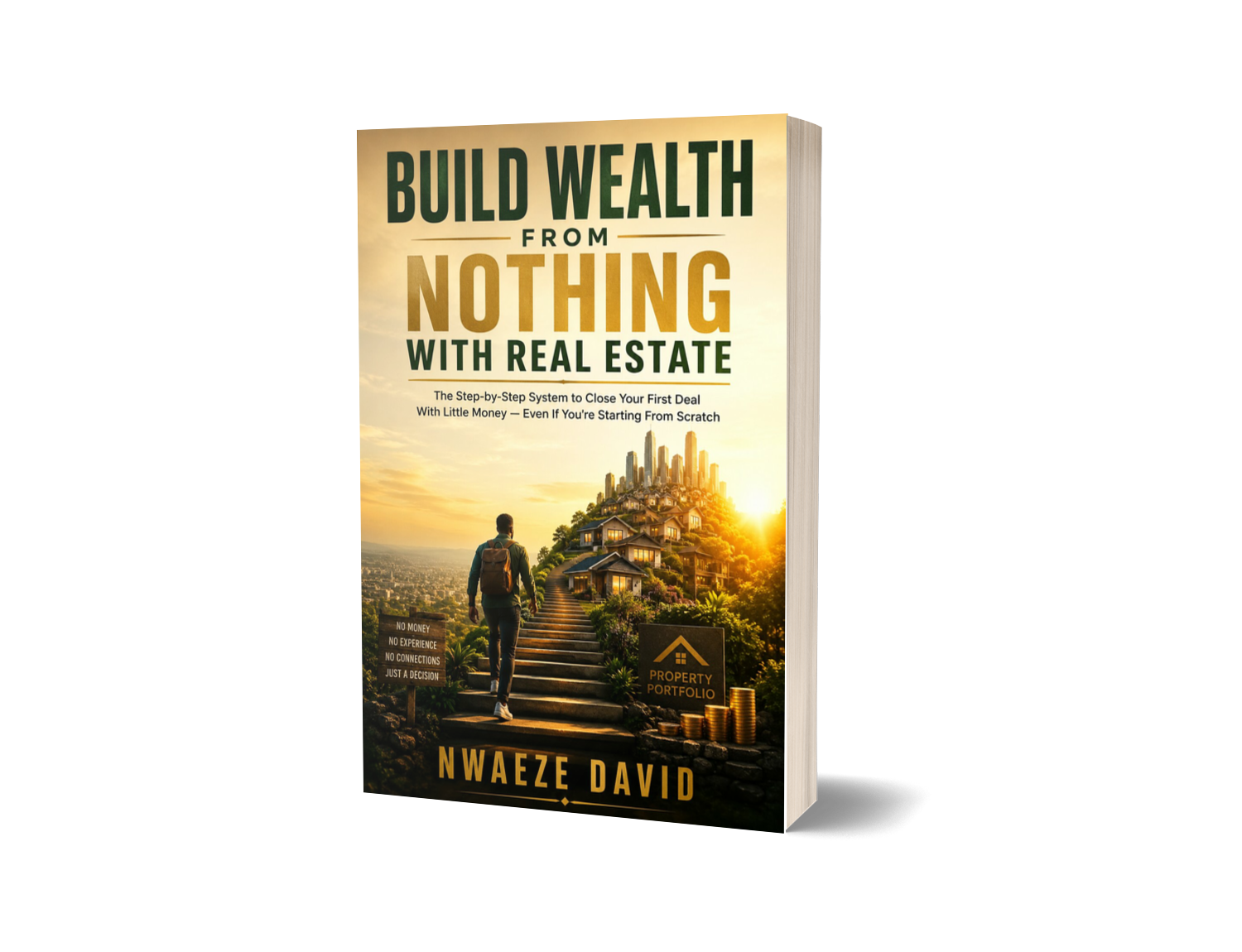
Beginner Wealth Building
Build Wealth From Nothing With Real Estate
"You don't need a big deposit, perfect credit, or family money to build wealth in real estate. You need a system, the resourcefulness to work it, and the courage to start."
Get Your Copy →
AI & Automation
The AI Real Estate Investor
"The AI Real Estate Investor gives you that system. It shows you exactly how to point AI at the parts of your business that actually make money."
Get Your Copy →
Diaspora & Africa
The Diaspora Property Blueprint
"The Diaspora Property Blueprint is the complete, step-by-step system for buying land and building wealth back home safely, from anywhere in the world."
Get Your Copy →Get more low-capital strategies like this
Join the newsletter for practical lessons on building wealth through property, then step inside the private community where we break down real deals and the strategy behind starting with what you actually have.
Keep learning: real estate investing for beginners · house hacking · how much money do you need to invest in real estate? · wholesaling real estate · what are REITs and how to invest in them.
Education only, not financial or legal advice. Every strategy described carries real risk, including loss of capital. Platform minimums, loan terms, and figures are illustrative and change over time; confirm current details before acting. Speak to a licensed professional before making any investment decision.