
Real estate investing strategies range from ten-dollar REIT shares to full property renovations, and picking the wrong one for your capital, time, and risk tolerance is the fastest way to burn out or lose money. Here are 15 genuinely distinct paths, grouped by who each one actually fits.
What's Inside

Real estate investing strategies get lumped together as if they are all variations on the same thing: buy property, make money.
In reality, sourcing a fourplex to house hack, buying ten dollars of REIT shares, and flipping a distressed home have almost nothing in common beyond the word "real estate." Choosing the wrong one for your available time and capital is a common reason people quit before they see results.
Below are 15 distinct strategies, grouped by who each one genuinely fits, from total beginners to investors ready for something more advanced.
Quick honesty note
This is education, not financial advice. Every strategy below carries real risk, including loss of capital, and none of them guarantee a specific return.
Confirm current terms, minimums, and rules for any strategy before committing money, and speak to a licensed professional about your specific situation.
Choosing a Strategy, in One Paragraph
In short: The best real estate investing strategy is the one that matches how much capital, time, and hands-on effort you actually have right now, not the one with the highest theoretical return.
Beginners typically do best starting with house hacking or a buy-and-hold rental. Those short on time or capital often start with REITs or crowdfunding.
Experienced investors with time to spare gravitate toward flipping, wholesaling, or scaling a rental portfolio.
Beginner-Friendly Strategies
1. House Hacking
Buy a small multi-unit property, live in one part, rent out the rest. Owner-occupied financing means a far lower down payment than a pure investment loan, and tenants cover most or all of your mortgage.
The strongest starting point for most beginners. Full guide: house hacking.
2. Buy-and-Hold Rentals
Buy a property, rent it to tenants, hold it for years. Cash flow, appreciation, and loan paydown compound quietly in the background. Simple, proven, and the foundation most portfolios are built on.
Read the full guide here: rental property investing.

3. BRRRR (Buy, Rehab, Rent, Refinance, Repeat)
Buy a distressed property below market value, renovate it, rent it, then refinance based on the new appraised value to recycle most of your capital into the next deal.
Powerful, but demands more skill and patience than the other two beginner strategies. Full guide: BRRRR method explained.
Passive and Hands-Off Strategies

4. REITs
Buy shares in a company that owns income-producing property. Fully liquid if publicly traded, and some can be bought for the price of a single share. The lowest-effort strategy on this list. Full guide: what are REITs and how to invest in them.
5. Real Estate Crowdfunding
Similar to REITs but often tied to specific properties or funds, with minimums on some platforms as low as $10-$100. Less liquid than a public REIT, but still fully passive.
Read the full guide here: real estate crowdfunding platforms compared.
6. Real Estate Syndication
Pool capital with other passive investors into a large property managed entirely by a professional sponsor. Minimums typically run $25,000-$100,000 and usually require accredited investor status, but the entire operational burden sits with the sponsor.
Read the full guide here: real estate syndication.
7. Turnkey Rentals
Buy a property that is already renovated and tenanted, often with property management bundled in. You own it directly, with the tax benefits that come with that, but the day-to-day is handled for you. A premium price buys the convenience.
8. Real Estate Note Investing
Instead of buying the property, you buy the mortgage debt secured against it, stepping into the lender's position to collect principal and interest.
Performing notes trade at a modest discount and behave like a bond; non-performing notes trade at a steep discount and demand active work to bring the borrower current or foreclose. 2026 has seen an unusually active supply of distressed notes as a large wave of commercial mortgages matures.
Active and Hands-On Strategies
9. Fix and Flip
Buy a distressed property, renovate it, and resell for a profit, usually within months. Needs real project management skill and enough capital to absorb holding costs if the sale takes longer than planned.
Read the full guide here: Understanding fix and flip in Real Estate.
10. Wholesaling
Put a property under contract at a favorable price, then assign that contract to a cash buyer for a fee, without ever taking ownership.
The lowest-capital active strategy, but demands real hustle and awareness of your state's compliance rules, which have tightened in several states recently.
Read the full guide here: wholesaling real estate.
11. Short-Term Rentals
Host guests by the night rather than signing long-term tenants. Can earn two to three times a long-term rental in the right location, but demands active hosting, furnishing, and navigating local short-term rental regulations.
Read the full guide here: how to start an Airbnb business.
Advanced, Niche, and Creative Strategies
12. Multifamily and Commercial Investing
Move beyond single-family homes into apartment buildings, office, retail, or industrial property. Larger capital requirements and a different set of numbers (NOI, cap rate), but income-focused and less tied to any single tenant.
Read the full guide here: commercial real estate investing.
13. Triple Net (NNN) Lease Investing
The tenant pays rent plus property taxes, insurance, and maintenance directly, leaving the owner with very little hands-on responsibility.
Popular with investors who want predictable, low-management commercial income. Full guide: triple net (NNN) lease investing explained.
14. Seller Financing
The seller acts as the bank, and you make payments directly to them instead of a traditional lender. Useful when you cannot qualify for conventional financing or want more flexible terms than a bank would ever offer. Full guide: seller financing.
15. Land Investing and Land Banking
Buy undeveloped or underdeveloped land and hold it, often for five to fifteen years or more, betting on appreciation as an area develops.
Low ongoing costs (mostly property taxes), no real income unless leased for farming or similar use, and genuinely illiquid until the market moves your way. A patient, long-horizon play, not a quick strategy.
How to Actually Choose
Swipe to see more →
| If you have... | Consider... |
|---|---|
| Little capital, willing to live in the property | House hacking |
| Little capital, more time than money | Wholesaling |
| Some capital, want fully passive | REITs, crowdfunding |
| $25,000+, want passive but higher-touch reporting | Syndication |
| Capital and renovation skill or crew | Fix and flip, BRRRR |
| Capital and patience, no interest in management | Land banking, NNN leases |
| Want to scale a long-term rental base | Buy-and-hold, multifamily |
Common Mistakes (and How to Dodge Them)
- Chasing the highest-return strategy regardless of fit. A strategy that demands ten hours a week you do not have will underperform one you can actually sustain.
- Trying several strategies at once as a beginner. Master one before adding a second. Splitting focus early slows learning on all of them.
- Ignoring the illiquidity of passive vehicles. Syndications and land banking can lock up capital for years. Never invest money you might need soon.
- Underestimating active strategies' time demands. Flipping and wholesaling are businesses, not side hustles you run in spare minutes.
- Not revisiting your strategy as life changes. The right strategy at 25 with lots of time may not be the right one at 45 with a demanding career. Reassess periodically.
FAQs about Real Estate Investing Strategies
What is the best real estate investing strategy for beginners?
House hacking is often the strongest starting point, since owner-occupied financing offers a low down payment and tenants can cover most or all of your mortgage.
A straightforward buy-and-hold rental is a close second for beginners who are not ready to live in an investment property.
What real estate strategy requires the least money?
REITs and some crowdfunding platforms let you start with as little as $10 to $100. Wholesaling can also require very little capital, often just an earnest money deposit, though it demands significant time and effort rather than cash.
What is the most passive real estate investing strategy?
Publicly traded REITs are typically the most passive option, requiring no property management and offering full liquidity to buy or sell shares.
Real estate syndications and crowdfunding platforms are also fully passive but usually less liquid, since your capital is tied up until a refinance or sale event.
Which real estate strategy has the highest potential return?
Active strategies like fix and flip, wholesaling, and BRRRR generally offer the highest potential returns because you keep the full value you create rather than sharing it with a sponsor or platform. They also carry the most risk and demand the most time, skill, and hands-on management.
Can I combine multiple real estate investing strategies?
Yes, and many experienced investors do. A common path is starting passive with REITs or crowdfunding to learn how real estate income behaves, then adding an active strategy like buy-and-hold or house hacking once you have more capital and confidence, and eventually layering in more advanced strategies as your portfolio grows.
How do I know which real estate strategy is right for me?
Start by honestly assessing three things: how much capital you have, how much time you can realistically commit each week, and how much control you want over decisions.
Match those answers to the strategies above rather than picking based on which one promises the highest return, since the best strategy is the one you can actually sustain.
Pick One, Master It, Then Expand
Fifteen strategies is a lot of choice, and that is the point: real estate investing is not one path, it is a spectrum that can fit almost any budget, schedule, and risk tolerance.
Pick the one that matches where you actually are right now, learn it properly, and let it fund your next move once you are ready to expand.
Take This Further
Books by Nwaeze David to help you build real wealth through property.
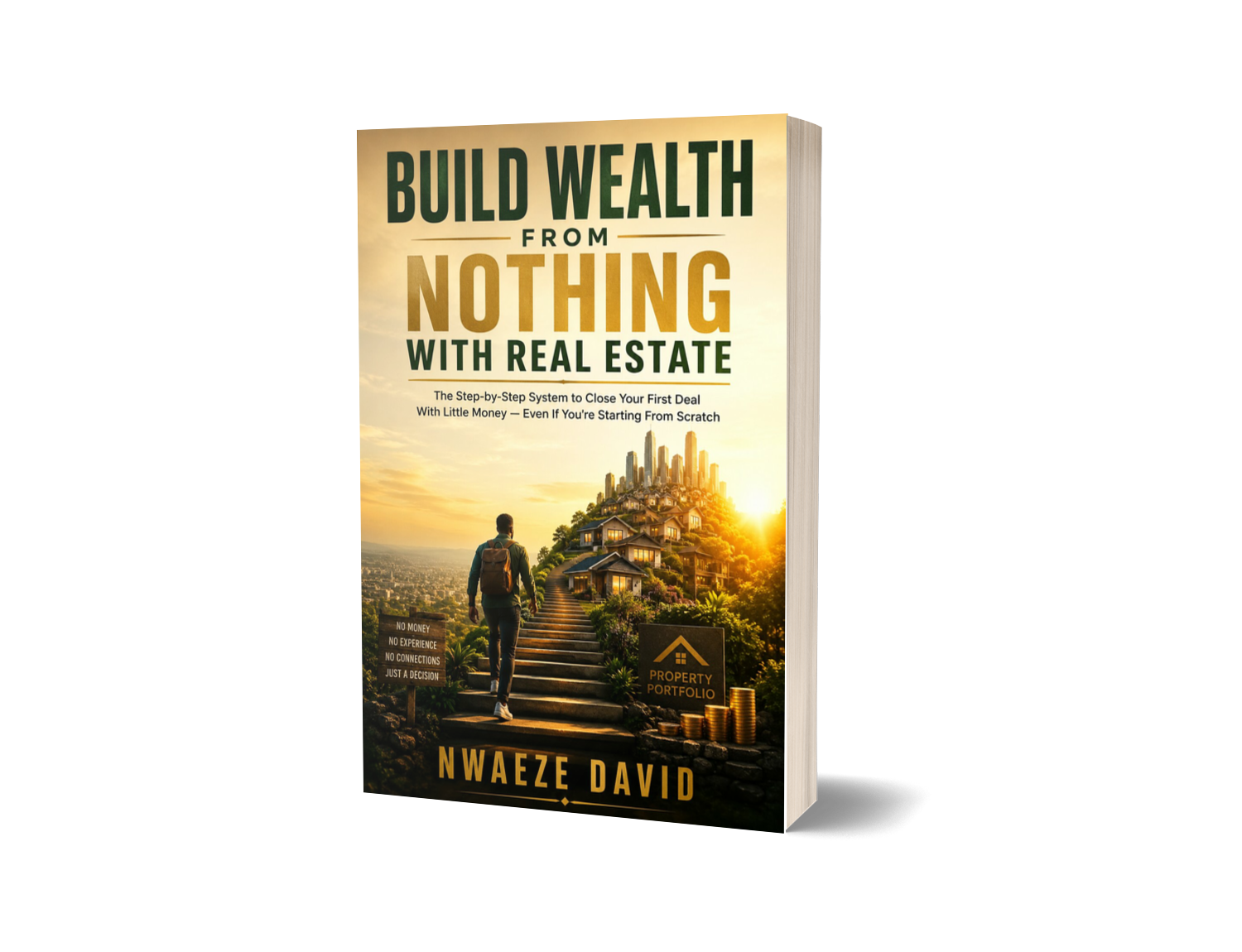
"You don't need a big deposit, perfect credit, or family money to build wealth in real estate. You need a system, the resourcefulness to work it, and the courage to start."
Get Your Copy →
"The AI Real Estate Investor gives you that system. It shows you exactly how to point AI at the parts of your business that actually make money."
Get Your Copy →
"The Diaspora Property Blueprint is the complete, step-by-step system for buying land and building wealth back home safely, from anywhere in the world."
Get Your Copy →Get help picking the right strategy for you
Join the newsletter for practical, no-hype breakdowns of every real estate strategy, then step inside the private community where we help you match a strategy to your actual capital, time, and goals.
Keep learning: real estate investing for beginners · how to start investing in real estate with little money · active vs passive real estate investing explained · how much money do you need to invest in real estate? · how to build a real estate portfolio from scratch.
Education only, not financial advice. Every strategy described carries real risk, including loss of capital, and past performance never guarantees future results. Minimums, returns, and rules vary by platform, sponsor, and jurisdiction, and change over time. Speak to a licensed financial professional before choosing or combining any of these strategies.

Written by
Nwaeze David
Nigerian digital entrepreneur, educator and author of three real estate books. He writes practical, honest guides for new investors, working realtors and Africans building back home from abroad.


